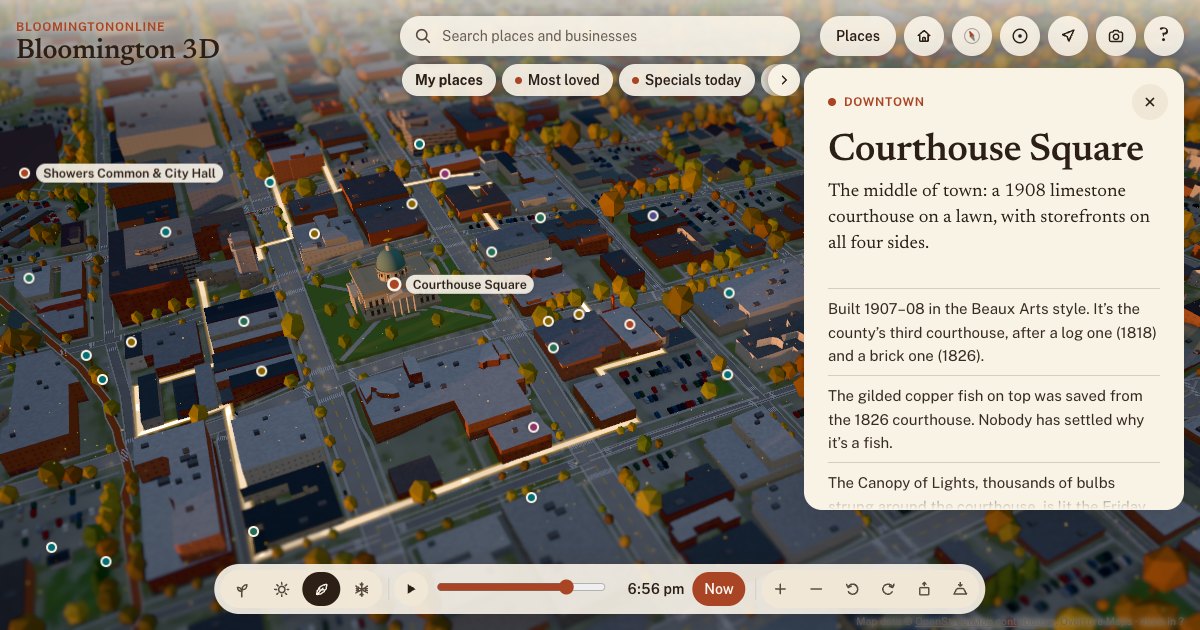
Bloomington has a longer list of international groceries and specialty food shops than most towns its size. We put eleven of them on a guided tour of the 3D map, so you can fly from one to the next and see how they sit around town.
Take the International markets tour on the 3D map → Latin, Asian, Indian, Afghan, Mediterranean and Italian food shops: from North College Avenue through downtown, south on Walnut, then out the east side.
The stops run from north to south and then out the east side. Each links to its directory listing, and its card on the map has the details we could confirm from the shop itself or from the City of Bloomington’s list of local grocers.
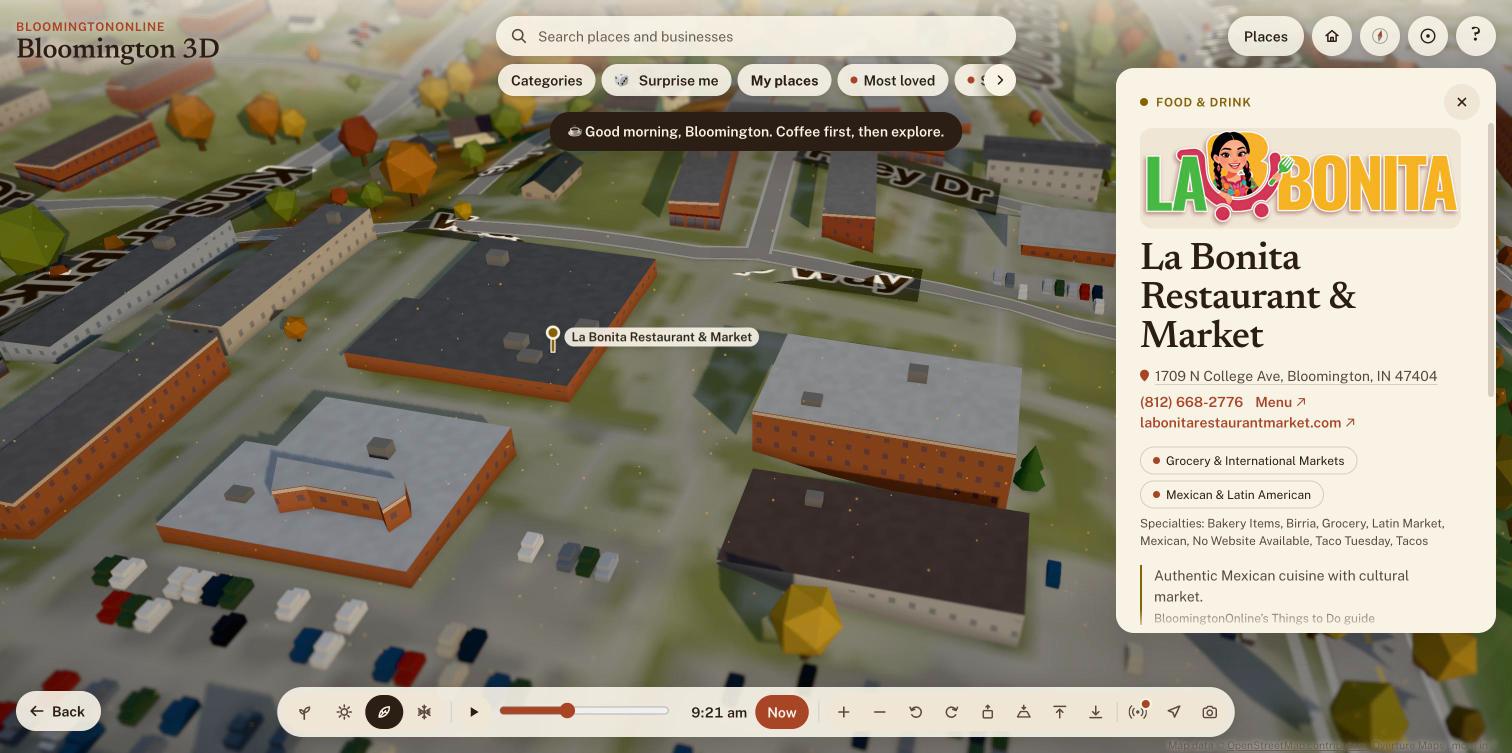
La Bonita Restaurant & Market: North College Avenue. A Mexican restaurant with a Latin market: tacos and birria on one side, groceries and baked goods on the other.
World Foods Market: Downtown at 2nd and Walnut. Foods from Europe, Asia and Latin America, with Nazareth Sweets pastries, olives, flatbreads, wine and sake.
Kabul Corner: An Afghan teahouse on East Third Street, open since December 2025: milk tea and pink tea, paratha naan, cardamom cookies and handwoven rugs.
4th Street International Market: A deli and grocery with gyros, spanakopita, hummus, spices and halal meats, in the same building as Dats Cajun Creole Cafe and Btown Gyros.
Little Italy Market: An Italian market and deli: pasta, olive oils, cheeses, salamis, sandwiches and cannoli.
Btown Bodega: A small market in Suite 6B of the same East Third Street building as Little Italy Market.
La Bodega Latin Market: South Walnut. A Latin grocery with a restaurant counter: breakfast, tacos, burritos and dessert ingredients such as dulce de leche.
The Olive Leaf: A tasting shop with more than 40 olive oils and vinegars on tap, plus pastas, Indiana foods and handmade chocolates.
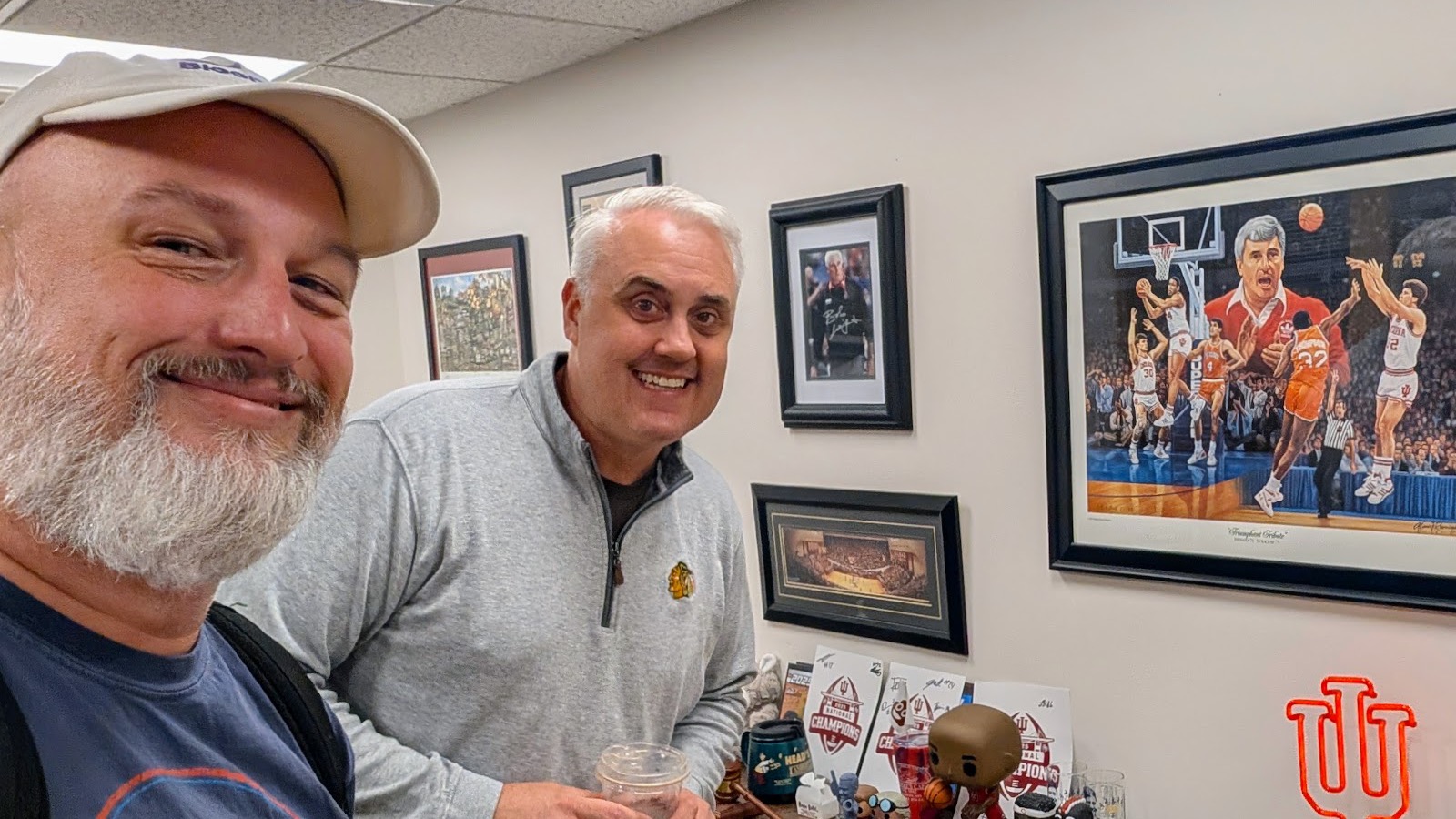
This morning I made a trip into the city to meet Andrew Lambert, the consultant behind Lambert Consulting and the host of the Mind Yo' Business podcast, and show him what I built on Bloomington Online over the last three days. He pulled up his own business listing in our directory. It was there, but it was nearly blank. This post is a thank-you to Andrew for the work he does in our community, and an account of how we fixed his listing and then rebuilt the south side of the Courthouse Square from a pile of photographs.
Andrew started his advertising agency in 2010 and launched the Mind Yo' Business podcast in 2017. Lambert Consulting helps owners with traditional marketing, digital advertising, websites and hosting, and one-to-one consulting. The podcast has run for nine seasons and is often recorded live in front of an audience at Morgenstern Books on South Auto Mall Road. Season 9 this year has included conversations with Brian Dorsey of Meineke Car Care Centers, the team at Brightside Cafe, Jordan Davis on food and festivals in Bloomington, and Kaytee Lorentzen on the Chamber of Commerce.
The Greater Bloomington Chamber of Commerce profiled him in April as part of its Small Business Series. It describes a former professor and stand-up comedian who wanted interviews to feel like a real conversation, with very few scripted questions and room for the mistakes and pivots that most people leave out. His idea of being "selflessly selfish" is that you can chase your own success as long as you create value for the people around you, and his advice to people starting out is to be real, stay flexible and take action.
He also gives back. On his own site Andrew says he served as Marketing Director and then President of the Monroe County Autism Foundation, founded in 2011, and as an advisor and contributor to the Katie and Victor Root New Hope Scholarship at Ivy Tech Community College, which helps adult learners return to school. He is the author of Be the Lime: An Insider's Guide to College.
If you own a business in Bloomington and you haven't heard the show, start with the episodes. If you need help with your marketing or your website, he is a good person to call.
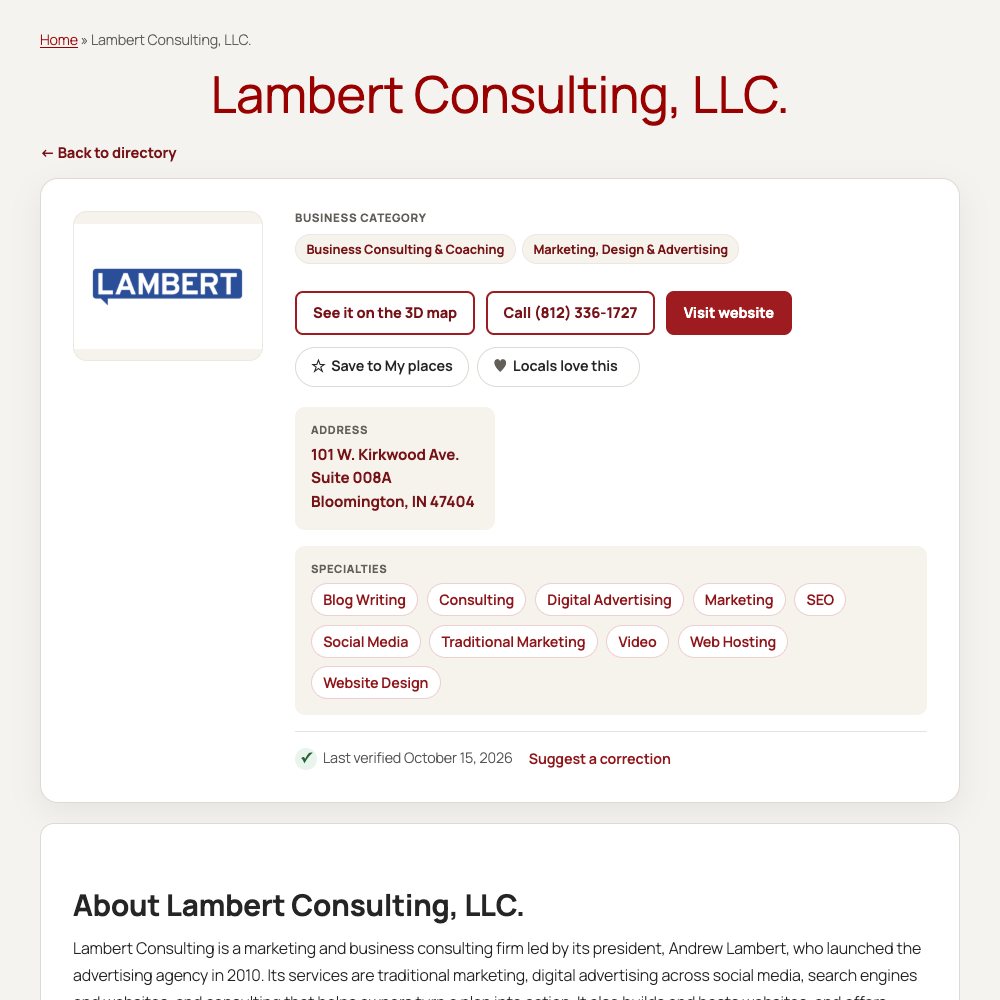
Andrew's listing in the Bloomington Online directory today.
The blank listing
When Andrew looked himself up in our directory, he found a one-line placeholder that had been generated automatically when the directory was first filled in. That is the kind of thing I have been cleaning up all week, and it was a good reminder of how many businesses are in the same position. So we fixed it. I opened Claude Code in the Terminal, told it whose listing to improve, and it read his website and the sources about him, then wrote the description, added his logo, set the categories and tags, and corrected his website address. Every sentence in it traces to something he or a reputable source has published, and the old text is backed up. His podcast's listing, which was also a placeholder, was rewritten the same way and moved to the media category where it belongs.
That is the whole method. I describe the job in plain English, the assistant does the research and the typing, and I decide what goes on the site. A written note, a link, or a photograph is enough to get it started.
From eighteen photographs to a courthouse
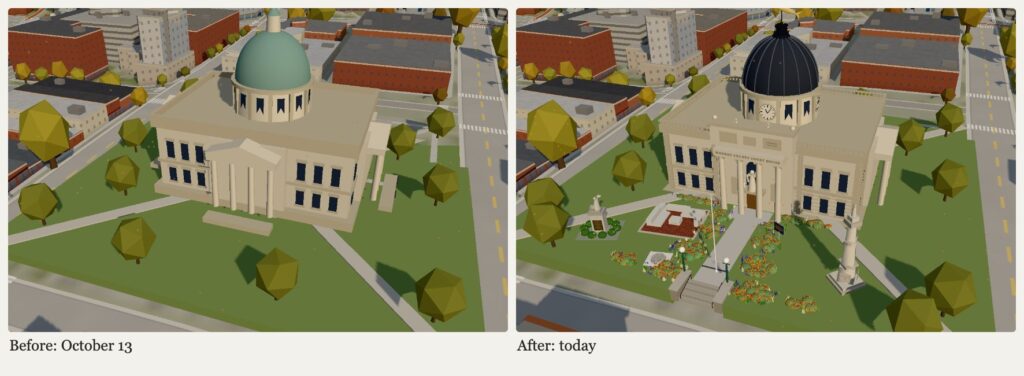
The part of the demonstration I enjoyed most was the photographs. The previous version of the courthouse in Bloomington 3D had a copper-green dome and a front with steps up to the doors. It was a fair miniature, but it was a guess. So I walked around the Courthouse Square and took eighteen photos: the south front, the stairs, the flower beds, the plaques, the stores across Kirkwood Avenue, and the fish on top. I gave them to Claude Code and asked it to make the model match.
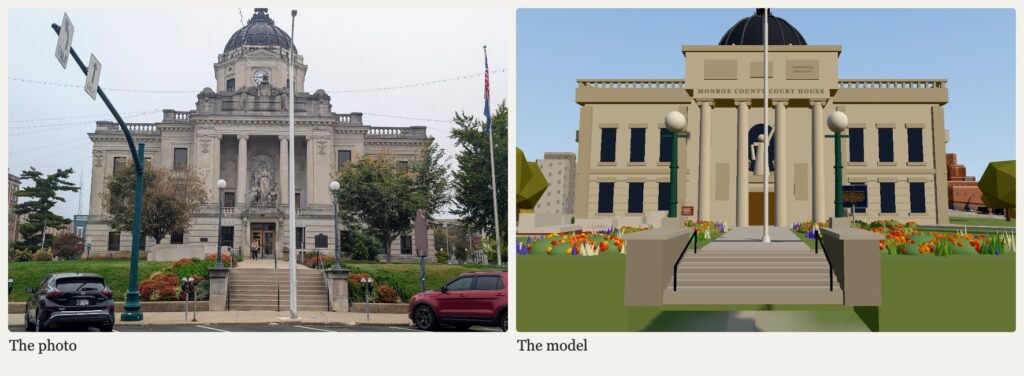
The south front of the courthouse, in my photo and in Bloomington 3D.
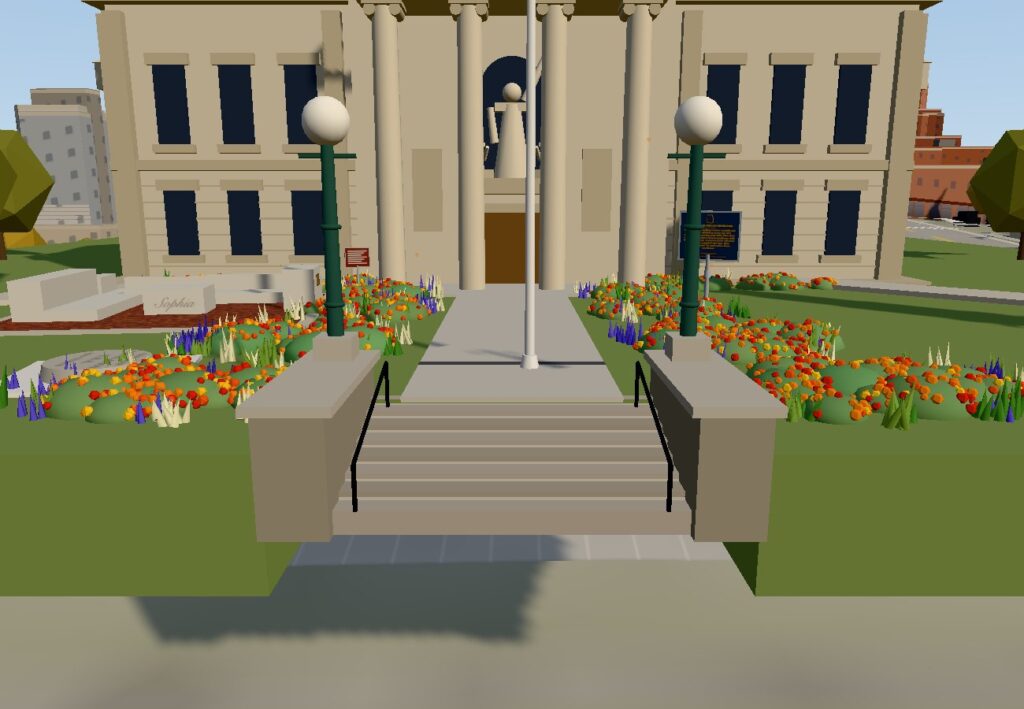
The photos corrected the model right away. The real courthouse has no steps at its doors. The long flight of stone steps with cheek walls and green lamp posts is down at the street, and a concrete walk crosses the lawn from there. The dome is dark and ribbed, with a clock on each face of the tower and an ornate crown at the top. The model now follows all of that, along with the lettering on the building, the "Anno Domini" panel, and the group of limestone figures over the entrance.
The Courthouse Square before and after.
The details on the lawn
The photos also showed what is on the lawn, and all of it is in the map now. A state historical marker stands beside the walk with its text about the 1818 log cabin and the brick courthouse that stood here until 1906. There is the Women in Government Plaza, with its stone benches and the block carved "Sophia," and a stone marking the Center of Population. A limestone memorial to county commissioner Warren Henegar, dedicated in 2013, carries its plaque and the words "Make me an instrument of Your peace." A tall war memorial topped by a soldier stands on the south lawn. The beds along the walk are full of orange and red flowers with blue salvia.
The steps at Kirkwood Avenue, with the lamp posts, rails and flower beds.
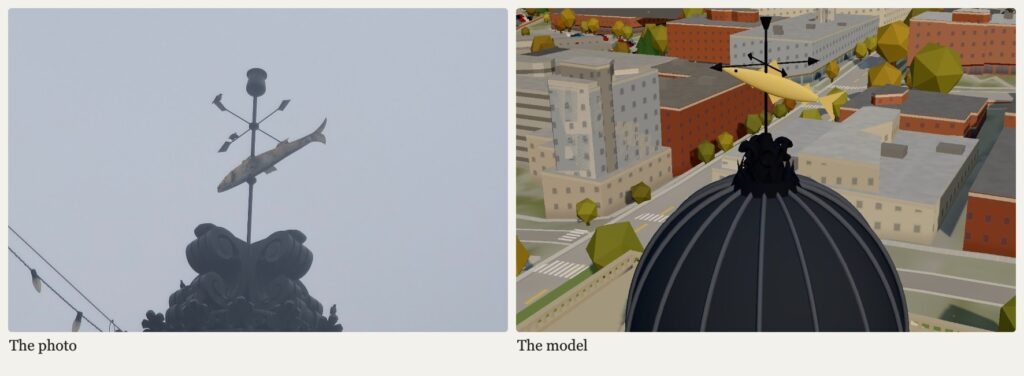
And the fish. Its weathervane is a long slim fish with a forked tail on a pole with four arrow-tipped arms, and the dome beneath it ends in a crown of leaves and scrolls. The old model had a plump fish on a lantern, so we rebuilt it. The fish swings slowly on its pole, as a weathervane should.
The weathervane on top of the courthouse, in my photo and in the model.
Across Kirkwood Avenue
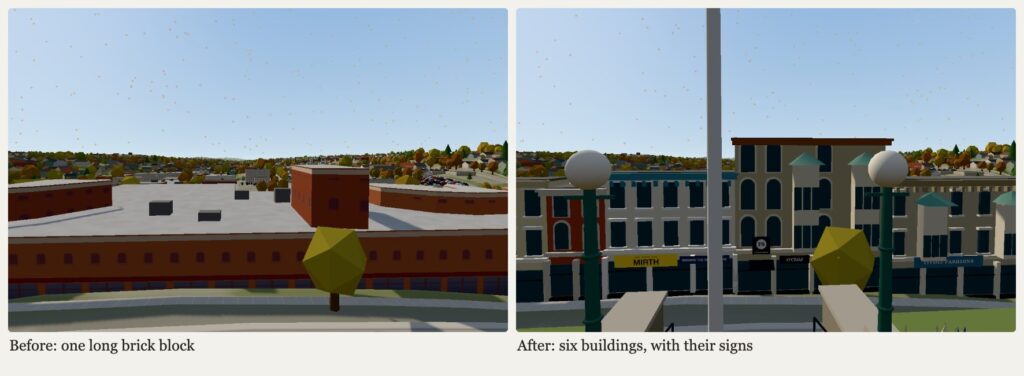
The storefronts were next. The old map had a single long brick building across from the courthouse. In reality it is six, each with its own color and character, so each one got its own front: the white building with blue-trimmed arched windows and the cream one beside it over Andrew Davis menswear and formalwear, a narrow red-brick building, the cream building with the teal cornice over Mirth and its "Browse the shops inside" sign, the tall limestone Fountain Square building with its black awning, O'Child and #skullznbunniez, and the limestone building with the oriel windows over Tivoli Fashions.
The stores across Kirkwood Avenue before and after.
These are still miniatures. The shapes and colors come from photographs taken from the lawn, so they are close but not exact, and the buildings along the rest of the Square are next.
How it works, in case you want to try it
I take photographs or write down what I want, and I put them in the Terminal where Claude Code is running.
It reads them, writes the code or the listing, and renders the result in a browser so it can check its own work.
I look at what it made, point out what's wrong, and it fixes it. Every change has a backup, so anything can be undone.
The listings follow a rule: no fact goes in unless it comes from a source I can point to.
AI makes mistakes, and today's first attempt put steps at the courthouse doors because that seemed reasonable. Photographs are what fixed it, and they are what I'd ask you for if you'd like your own business or building to look right on the map.
Visit, and say hello
Open Bloomington 3D and walk up to the courthouse from Kirkwood Avenue. Then look up Lambert Consulting and the Mind Yo' Business podcast in the directory. If you own a business, make sure your listing is correct. If it is not in the directory yet, let me know and I will add it. Thank you, Andrew, for the time and for the good work you do for Bloomington.
Yesterday we told you how Bloomington 3D came together in two days. Today was about everything behind it: the business directory. We rewrote hundreds of listings from sourced facts, rebuilt the category system so businesses are where you would look for them, added a way to see what is popular, and tuned the map so it follows the new categories. Here is what changed and why.
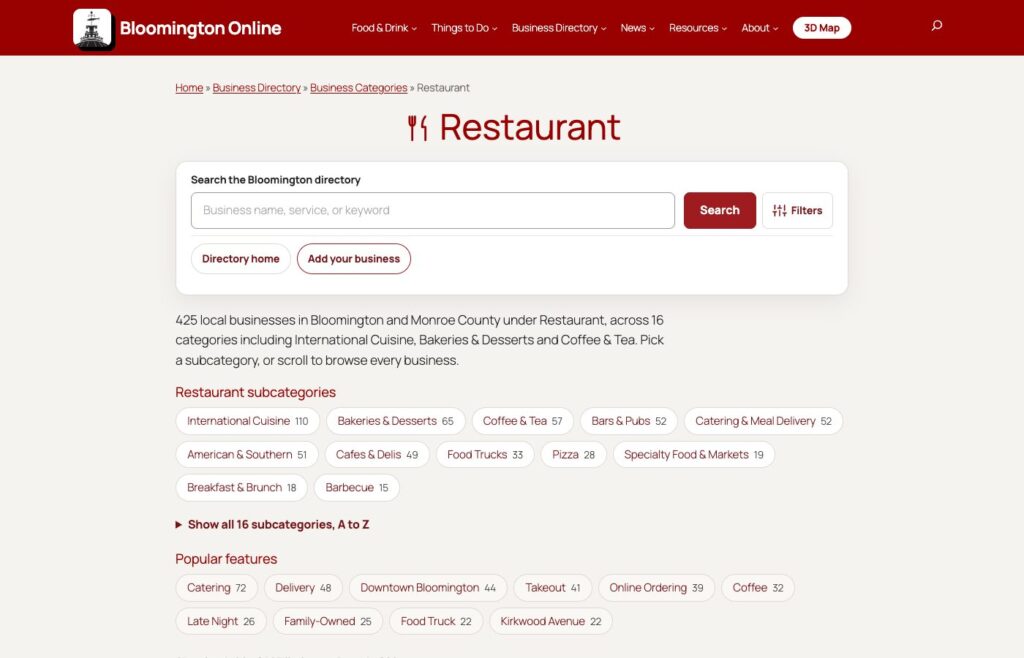
The Restaurant page now has 16 clear groups, with a count of businesses in each.
Why we started with the directory
Bloomington 3D shows every business in our directory on its building. That made the weak spots obvious. Many listings had a one-line description copied from an import. Some businesses had closed. Some websites had been taken over by spam. And the same restaurant could sit in four overlapping categories, so you could not tell where to look for pizza, or sushi, or a coffee shop that also bakes.
So today we did a cleanup, in four parts.
1. Food listings, rewritten from sources
The food and drink listings came first. For each of the 480 listings, we researched the business from its own website, its social pages, local news and guides. Then we wrote a new short description and a fuller write-up, fixed the categories, and added photos and logos where we could find them.
One rule made this safe: every fact in a description had to come with a source link and the exact words from that page, and a script then re-opened each page to confirm the words were really there. A sentence that could not be confirmed stayed out. If a business could not be confirmed as open, we did not rewrite it.
The result: more than 250 listings were rewritten and are live. The ones we could not verify were held back and reviewed one by one. About fifty listings that were closed, duplicated or not really in Bloomington were removed or merged, and every old web address for a merged listing now sends you to the one that is left. We also cleared the website link on a handful of listings where the old site had been taken over by an unrelated spam or gambling page.
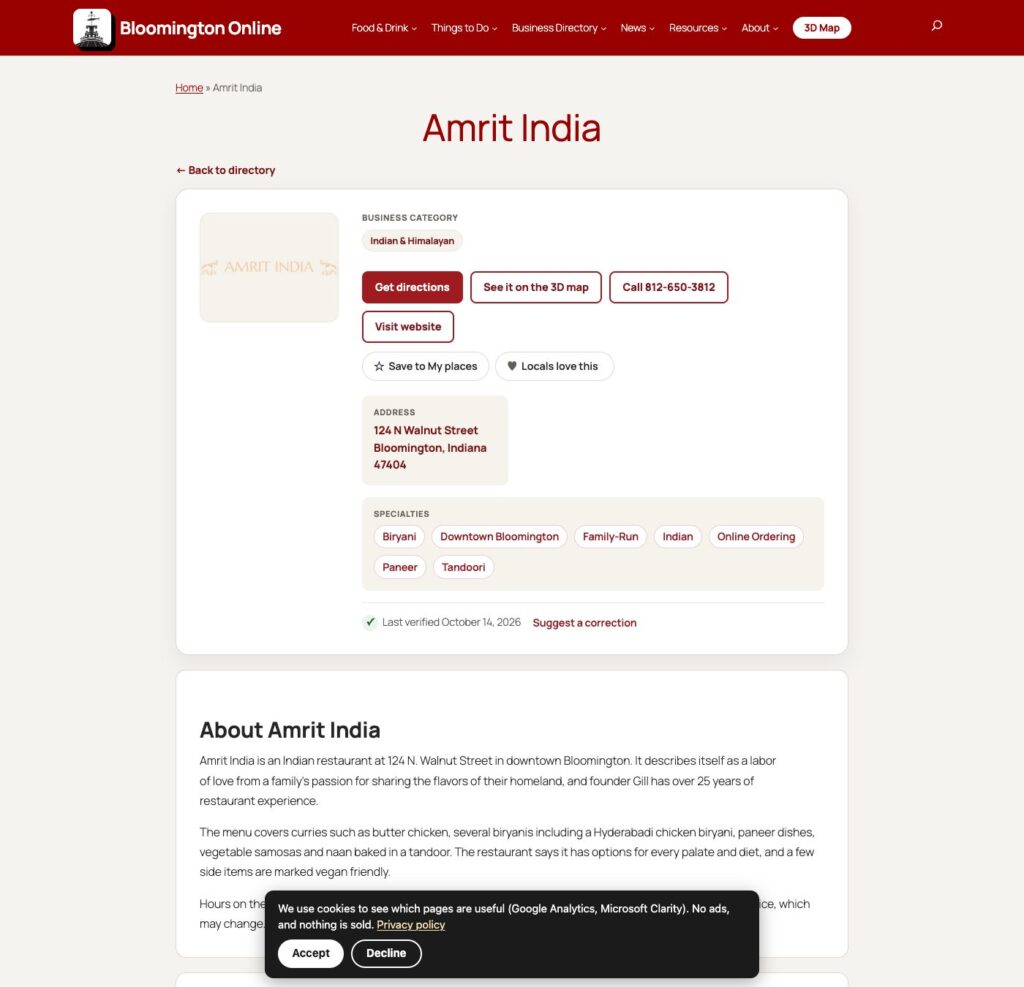
A rewritten listing: cuisine category, directions, the 3D map, specialties as tags, and the date it was last verified.
2. Categories that make sense
Under Restaurant there were 48 overlapping subcategories. We looked at how Visit Bloomington groups dining, how Yelp splits food from nightlife, and how our own listings had been tagged by several imports over the years. Then we reorganized: 16 groups, including American & Southern, Barbecue, Pizza, Breakfast & Brunch, Bakeries & Desserts, Coffee & Tea, Bars & Pubs, Breweries, Food Trucks, and one International Cuisine group that holds eight cuisines from Mexican and Latin American to Japanese & sushi.
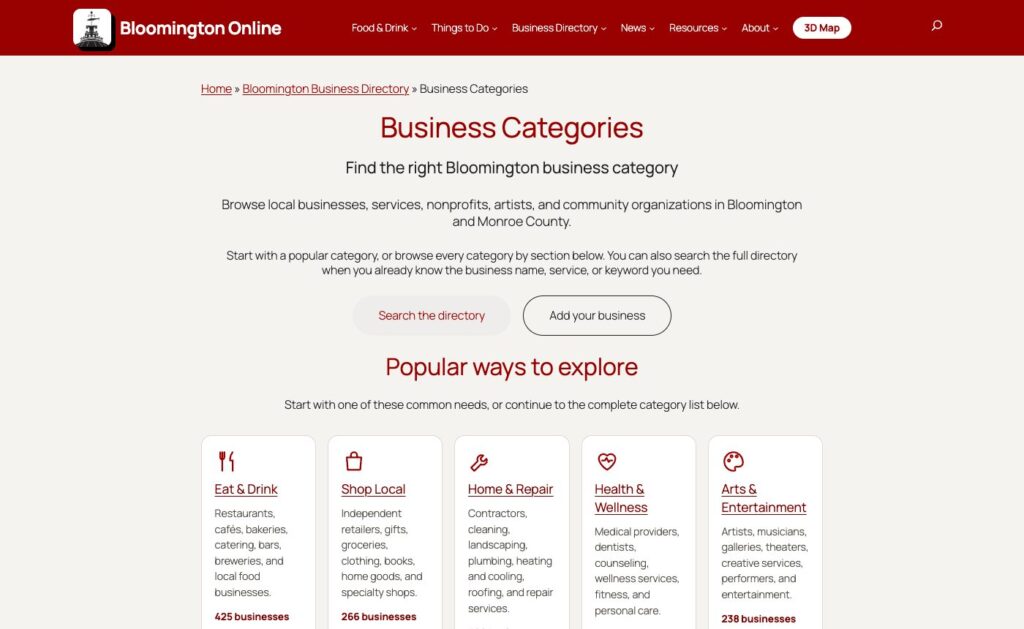
Then we did the same for everything else. The non-food categories went from about 313 to about 145, grouped under nine sections. The big catch-all, Professional Services, held 275 listings from a single import, with banks, law firms, insurance agents and car dealers all mixed together. They now sit in their own categories. More than 700 listings moved to a better home, and the number of listings with no category at all dropped from 141 to 26.
Tags got the same treatment. There were about 2,500, and most were used once, or just repeated the category name. We cut them to about 1,400 and fixed the capitalization.
The categories page lists every category by section, with live counts.
3. Category pages that help you choose
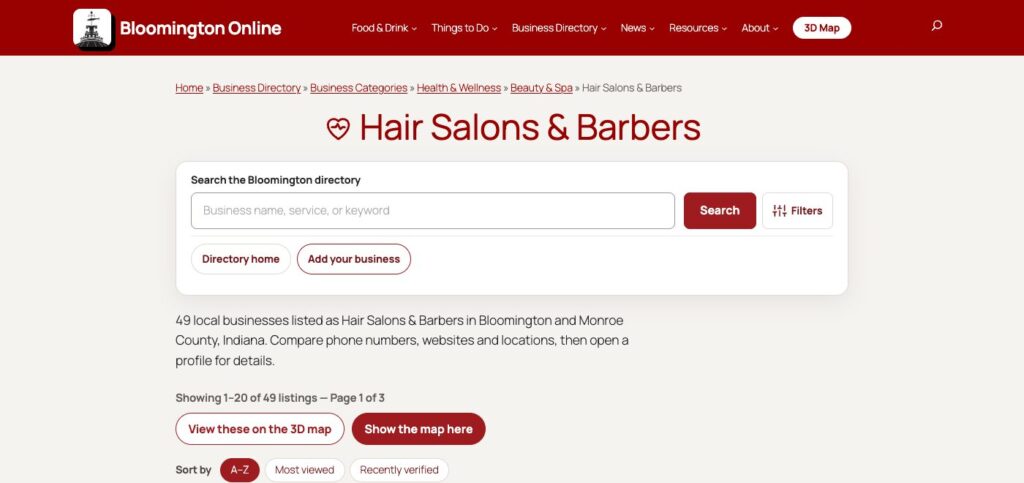
The category pages got a redesign too. Each now opens with a plain sentence about what is in it, subcategory chips, related categories and popular features such as Takeout, Online Ordering or Family-Owned. You can sort by A to Z, most viewed or recently verified, and long lists scroll without page buttons. A button on every category opens just those businesses on the 3D map.
A category page with search, a count of businesses, sorting, and buttons for the 3D map.
4. What people love, and what is new
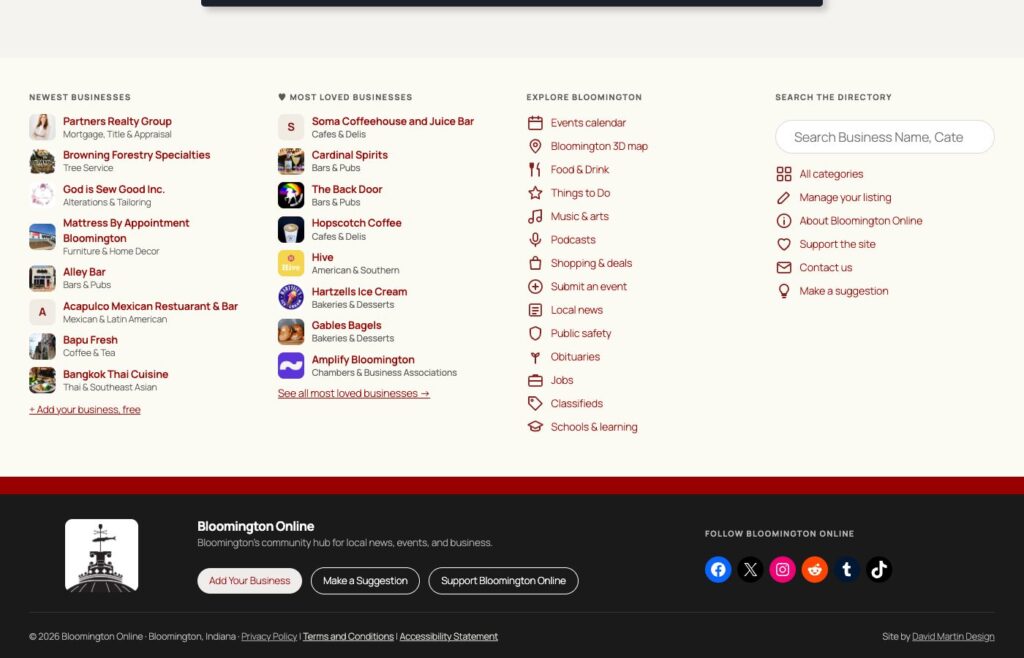
The footer now shows Most Loved Businesses and the newest businesses side by side, each with a photo or logo and its category, so a visit can start with what other people like. Listing cards also show a small visits count once a business has been looked at enough times for the number to mean something. Business owners get a traffic panel on their own listing that nobody else sees.
The new footer: newest businesses, most loved businesses, and links to explore Bloomington.
5. The map follows the new categories
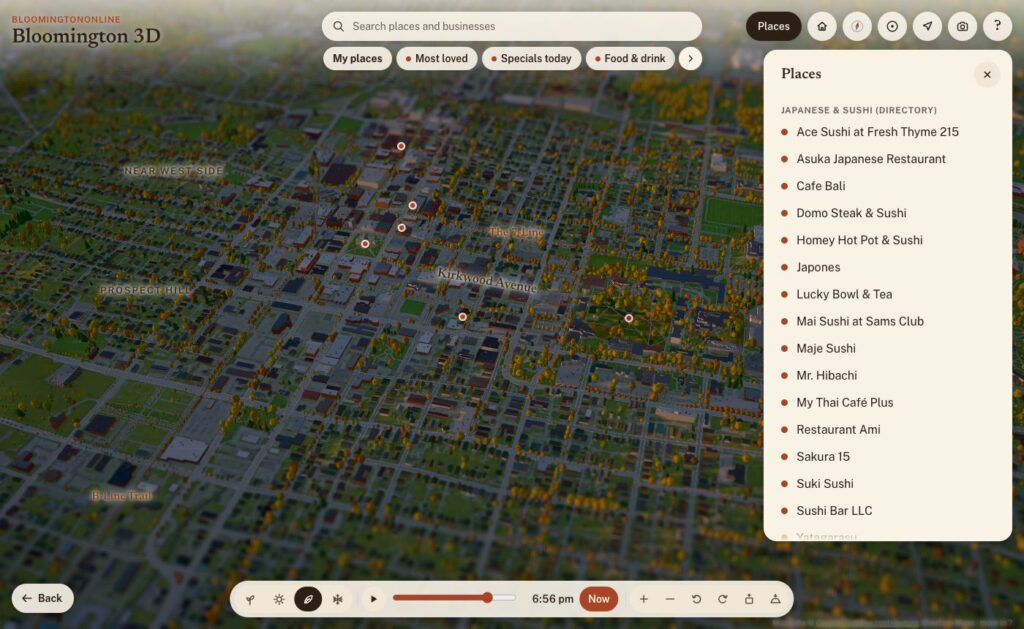
The 3D map groups its businesses by category, so we updated it to match. The chips along the top, such as Bars & pubs, Japanese & sushi, Bakeries & desserts, Coffee, Pizza, Breweries and Food trucks, now follow the reorganized food categories. Tap one and the pins and a list appear. The search box also finds businesses by tag and category and shows the short description on each card.
A few other things landed on the map today:
A Show where I am button, so you can find yourself in town. It uses your location only on your own device while you press it.
Specials today: daily food and drink specials from a calendar we keep of Bloomington bars and restaurants.
An Edible trees layer, built from the City and IU tree inventories after a reader pointed us to a community map of fruit and nut trees.
Most loved lists, and hearts and stars on directory cards. Votes are checked by Cloudflare Turnstile so one person cannot pile on, but it stays easy to love your favorites.
Tap a category chip and the matching businesses appear on the map and in a list.
6. Behind the scenes
Some of the work does not show on the page, but it is what makes the site findable.
Search engines now get specific labels. A dentist is marked as a dentist and a hotel as a hotel, and the directory keeps those labels working after the category renames.
Old addresses are redirected. Merged categories and tags, retired listings and old pages now send you to the closest live page instead of a dead end.
Pages are faster. Google’s Lighthouse test scores the home page 98 for performance on a phone, up from the 70s and 80s, and 95 to 97 for accessibility.
The new compact header puts a 3D Map button in the main menu.
We also added anonymous usage statistics to the map today, and this changes something we said yesterday. Bloomington 3D now uses Google Analytics to count what people tap, search for and share, so we can fix what is confusing and build what people use. It does not collect names or email addresses, and your saved places still stay on your own device. Our privacy policy explains how analytics are used.
The statistics already taught us something: about half of last month’s page views on the site were not people. They were automated bots, mostly in two short spikes in September. Knowing that makes every other number more honest.
How it was made
Like yesterday, this was a collaboration with AI. Several Claude Code agents worked side by side: one researching businesses, one reorganizing categories, one on the page design, one on analytics and redirects. Every change was saved with a backup first so that anything could be undone, and a person made the calls on anything uncertain. We got some things wrong along the way. The first time we nested the old categories under the ten top-level sections, we filed Aviation under Fitness. A day of looking at the live pages caught it, and it is fixed.
What is next
Researching the listings we could not verify yet, and finishing the last unclassified restaurants.
A short email digest of what is new and what is happening in town.
A way for business owners to claim and complete their own listing.
More of the 3D map: events, live weather and more guided tours.
Take a look around. Browse the new categories, open the map, and love a few favorites. If something is out of date or in the wrong place, use Flag this listing on any business card, or tell us. We read every one.
We use cookies to see which pages are useful (Google Analytics, Microsoft Clarity). No ads, and nothing is sold. Privacy policy