
-
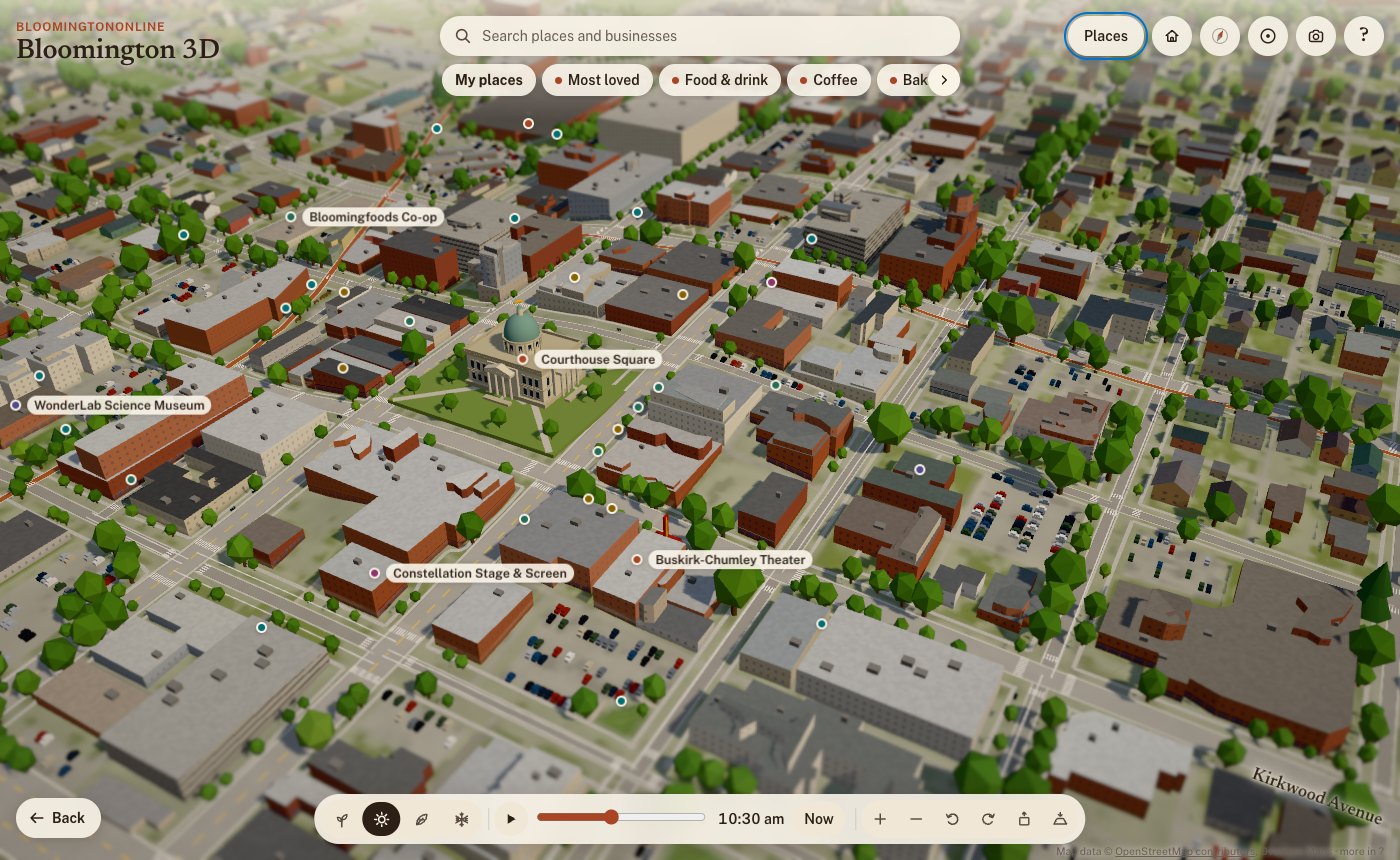
Two days ago there was no 3D Bloomington. Now there’s one you can fly around, from the copper fish on the courthouse to the sailboats on Lake Monroe. It’s built from real survey data, it lights up at dusk, it changes with the seasons, and every business in our directory can show up on it. Here’s what we built, where the data came from, and how it came together.
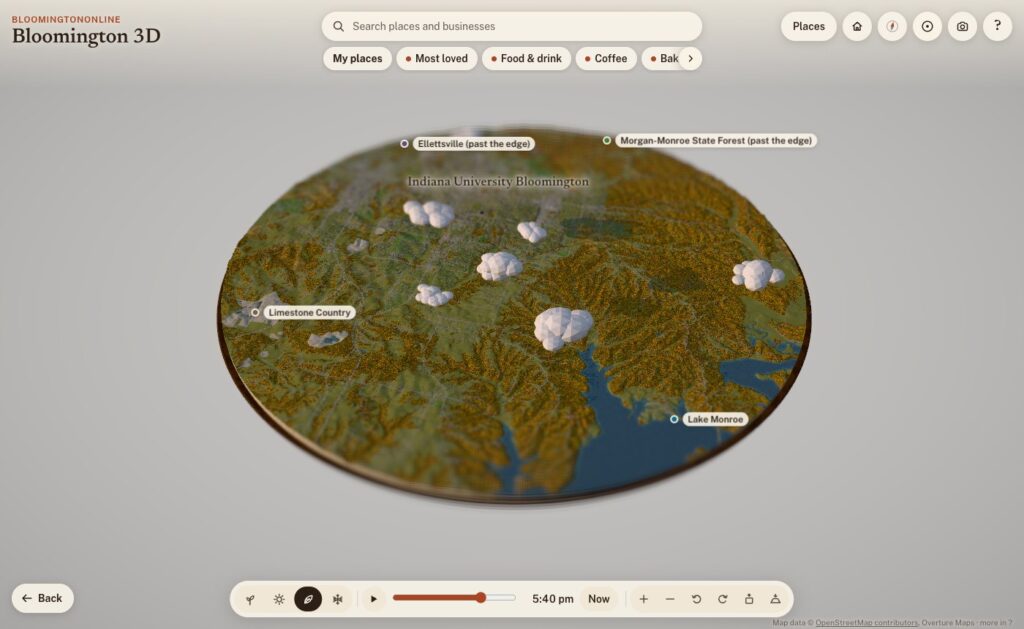
The whole board: Bloomington and the hills around it, about 12 miles across, on a fall evening. What it is
Bloomington 3D is a model of Bloomington and the country around it: a round board about 19 kilometers (12 miles) across, centered just south of downtown, sitting on a walnut plinth like a museum diorama. The cut edge shows layers of limestone, and where the board slices through Lake Monroe you can see the water in cross-section.
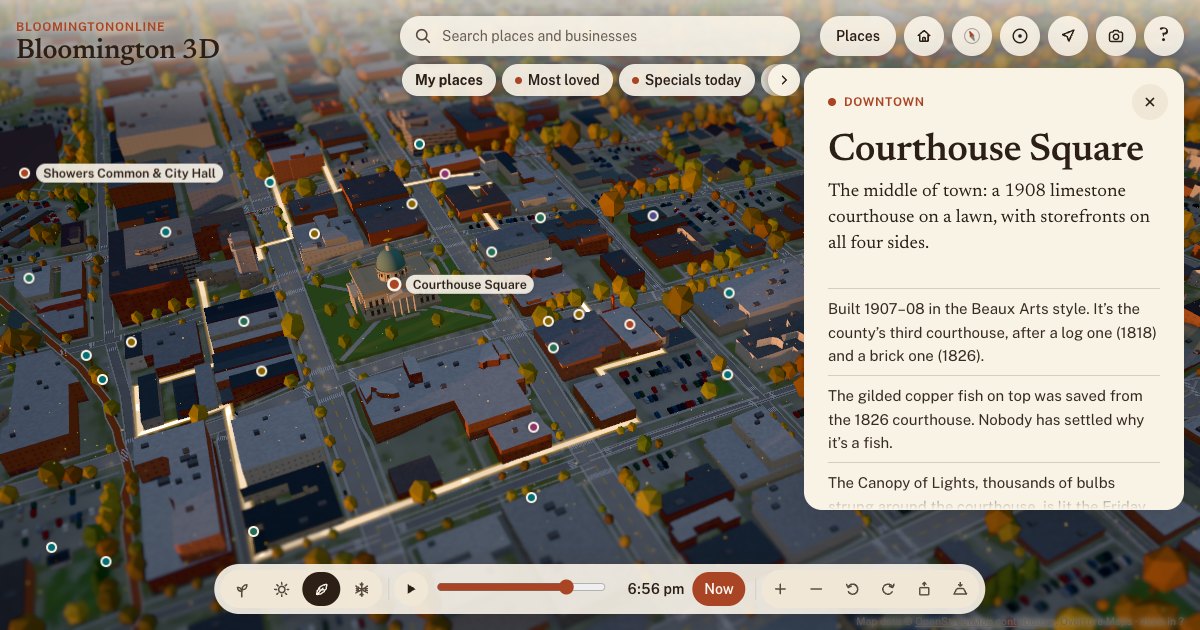
It runs in any modern browser, on a phone or a computer, with nothing to install. It opens on the Courthouse Square. Drag to move, pinch or scroll to zoom, and tap anything outlined, pinned or named to read about it. Each place has a card with a short, fact-checked write-up, nearby places to wander to next, and a link you can share. For example, bloomingtononline.com/town/#griffy opens straight onto Griffy Lake.
Where the town comes from
None of the geography is drawn by hand. Every street, building, tree and creek comes from public data, and the map credits each source on screen. Here’s what’s in it.
Streets, buildings and paths: OpenStreetMap
The base layer is OpenStreetMap, the volunteer-built map of the world. It supplies the roads, the B-Line and the other trails, the creeks, parks, rail lines and building footprints. It also has the small things you notice once you zoom in: about 2,900 sidewalk segments and 4,300 other footpaths, crosswalks, bike lanes, benches, bike racks, picnic tables and parking lots, which fill up with little parked cars.
The hills: USGS elevation data
Southern Indiana isn’t flat, and the model shouldn’t be either. The terrain comes from USGS elevation data via open terrain tiles, with the hills exaggerated about two times so the ridges and hollows read at a glance, the way a museum diorama does. Buildings and trees stand at their real heights. Where OpenStreetMap doesn’t map the woods, the model fills undeveloped slopes with forest, because that’s what our hollows are.
Real building heights: 154 million laser points
This is the part I’m proudest of. Indiana was flown with lidar between 2017 and 2019 for the USGS 3D Elevation Program: an airplane sweeps a laser across the ground and records where every pulse bounces back. We streamed the 21 tiles that cover downtown, campus, Prospect Hill, Elm Heights, Bryan Park and the near west side, which is 154.6 million points, and turned them into a one-meter grid of the town.
From that grid, the model measures:
- the eave and ridge height of 11,565 buildings, so roofs are the right height and the right shape
- stepped roofs on bigger buildings, traced in tiers every 3.5 meters, so a building with a tall section and a low wing looks like that
- towers that rise above the rest of a building
- the tree canopy, so the woods and big yard trees stand where they really are
- the bare ground under it all, more detailed than the terrain everywhere else
Outside that core, building heights come from Microsoft’s machine-learning estimates, published through Overture Maps, which also fills in buildings OpenStreetMap doesn’t have yet. All told, there are about 35,000 buildings on the board.
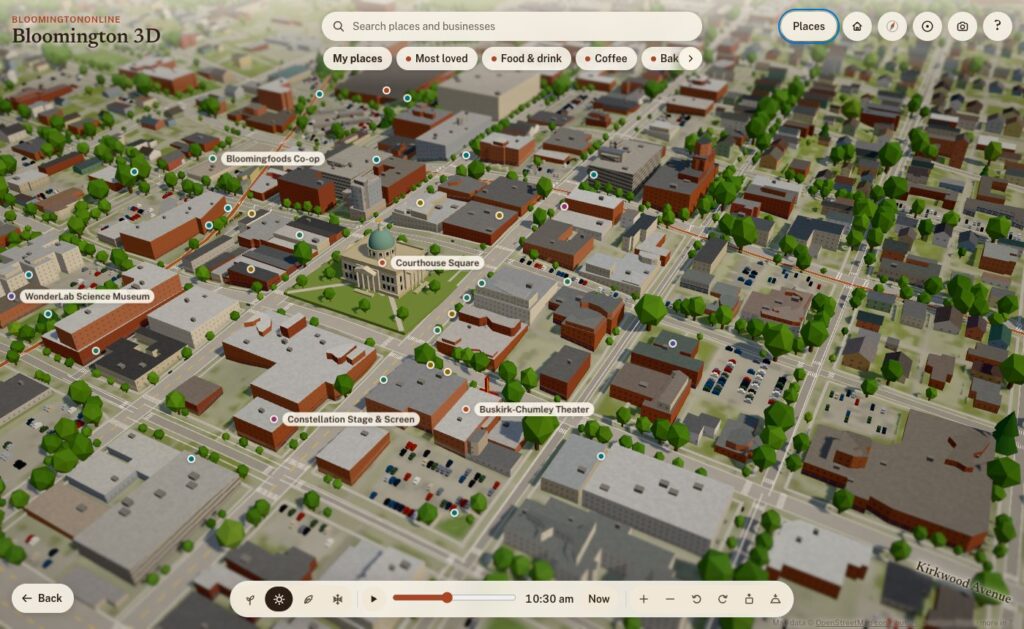
Downtown on a summer morning. Building heights and roof shapes are measured from lidar; roof colors come from the 2025 aerial photos. Roof colors: the 2025 aerial photos
Flying over a model where every roof is the same gray is boring, and it isn’t Bloomington. So for 11,518 roofs in the core, the model samples the real color from IndianaMap’s 2025 statewide aerial imagery: the red metal roofs, the white flat roofs on campus, the weathered shingles. The same photos also lighten the ground where there’s paving and green it where there’s grass. We use the photos as data, not as a texture, so everything stays in the model’s diorama style.
36,000 real trees, and fall colors by species
The City of Bloomington keeps an inventory of its street and park trees, and IU surveyed its campus trees in 2019. Together that’s about 36,000 trees on the board, each standing where it really stands, and each with its species. So in fall:
- red maples, sweetgums and red oaks turn red
- sugar maples turn orange
- tulip trees, ginkgos, honeylocusts and redbuds turn yellow
- white oaks, beeches and sycamores go bronze
- pines, spruces and cedars stay green
In spring, the redbuds and crabapples bloom pink and the dogwoods and pears bloom white. Dunn’s Woods and the campus look different from the near west side because they’re planted differently, and the model knows it. Beyond the inventories, trees follow the lidar canopy in the core and the landcover everywhere else.
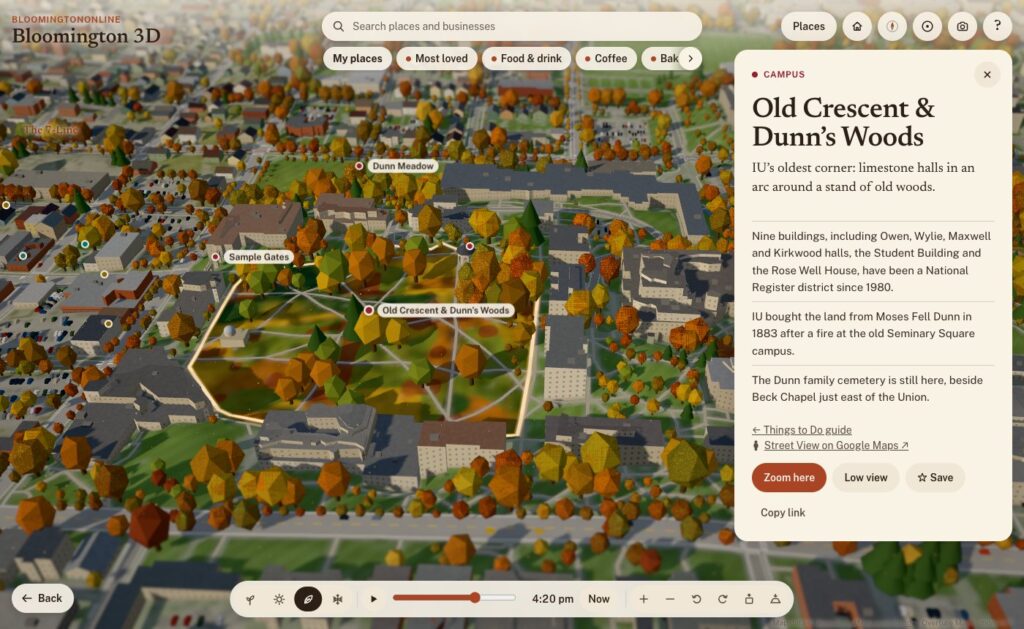
The Old Crescent and Dunn's Woods in fall. Campus trees come from IU's tree inventory and change color by species. The city’s own maps
From the City of Bloomington’s open data we use:
- Historic districts and neighborhood boundaries: outlines like Prospect Hill and Elm Heights are the city’s own.
- The bikeways layer.
- The historic buildings survey: houses it rates as historic get an older-house look in Elm Heights and Prospect Hill.
- The public art inventory: 42 outdoor works, each with the city’s photo, artist, year and medium. A “Public art” walk visits them in order, starting at the Square.
And BloomingtonOnline itself
Our own content is on the map too:
- Things to Do guide: 67 places, linked both ways.
- Neighborhoods guide: the north, east, south and west sides of town.
- The business directory: more on that below.
Light, time and the seasons
By default the model runs on live Bloomington time. The sun is where the real sun is, calculated for our latitude down to the minute, daylight saving time included. Watch it long enough and the shadows swing across the Square, the sky warms at golden hour, the street lamps come on, and the windows downtown light up after dark.
Live mode also follows the calendar, and the four season buttons let you jump ahead:
- Spring: the redbuds and dogwoods bloom.
- Summer: sailboats on Lake Monroe, paddlers on Griffy, and fireflies at dusk.
- Fall: the species colors, with leaves drifting down.
- Winter: snow on the roofs, wet streets and moonlit fields.
Some details only show up at the right moment. The farmers’ market tents are on Showers Common on Saturday mornings from April through October. From the Friday after Thanksgiving through December, the Canopy of Lights glows over the Square at night.
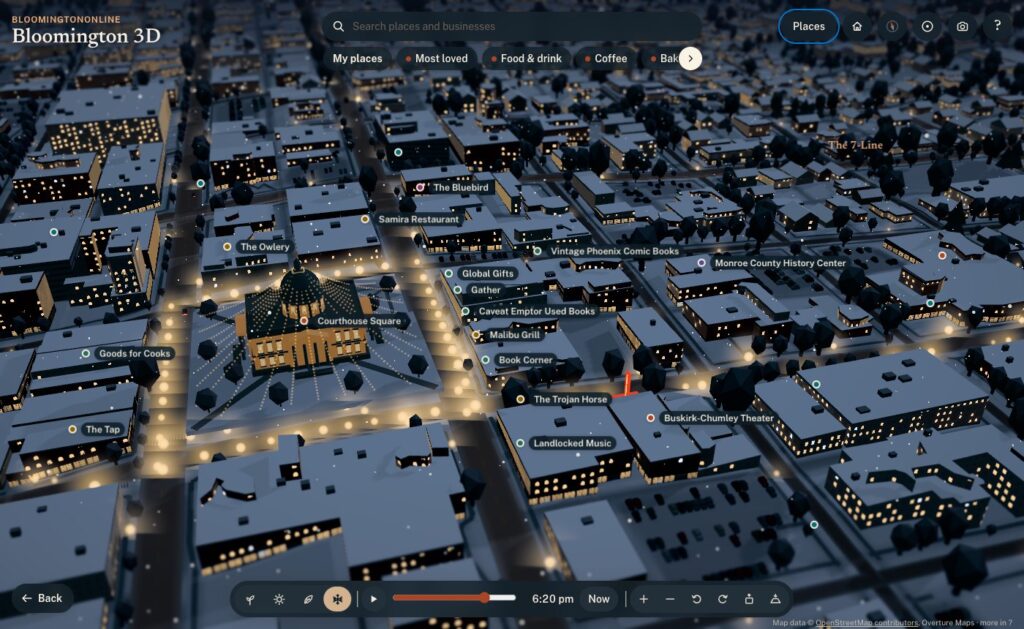
The Canopy of Lights over the Square, shown from the Friday after Thanksgiving through December. You can also link to a moment. Adding
?season=winter&time=18:30#squareto the address opens on the Canopy of Lights at dusk, which is handy for stories.Hand-built landmarks
Data gets you most of the way. A few places deserved to be modeled by hand:
- The courthouse: its dome and windowed drum, the copper fish weathervane, and window rows that light up at night.
- Campus: the Sample Gates, the Rose Well House, Kirkwood Observatory’s dome, Showalter Fountain, the IU Auditorium’s front and the field at Memorial Stadium.
- Downtown: the Buskirk-Chumley’s marquee and the sawtooth roof of the old Showers plant, now City Hall.
- The Little 500 track.
- Grout piles: heaps of waste limestone blocks along the rims of the quarries.
Older brick blocks within a few minutes’ walk of the Square get storefronts, awnings, arched upper windows and limestone cornices.
Ways to explore
- A first look: a guided tour of the highlights.
- Fly-alongs: rides along the B-Line, Kirkwood and out to Clear Creek. Nine more stay low: on foot down Fourth Street, College Avenue, Walnut, Third Street and 10th Street through campus, and by bike along the 7-Line, Cascades, Jackson Creek and the Karst Farm Greenway. The low routes were checked against the lidar so the camera clears every roof and treetop.
- Low view: drops you to about 10 meters, looking down the street toward the horizon. Smaller places link to Google Street View when you want the real photos.
- Circling: pick a place and the view slowly circles it, like Google Earth after a search.
- Home, Back and the compass: Home takes you back to the Square, Back to your last view, and the compass to north, then straight down.
- Save a picture: the camera button saves the current view as an image, credit included.
The business directory, on the map
This is where the model stops being a pretty picture and becomes part of BloomingtonOnline:
- Every business on its building. More than 1,900 directory listings now have a See it on the 3D map button. The model places each one on its actual building, matched by name and address against OpenStreetMap and Overture, instead of rough estimates from street address ranges. Businesses just past the edge of the board get a pin on the rim pointing their way.
- Categories as layers. The chips under the search box show one kind of business at a time: Food & drink, Coffee, Bakeries, Bars & nightlife, Pizza, Shops, Arts & entertainment, and Fitness & recreation. More has every directory category. Category pages in the directory link to their view on the map, so coffee is one tap away.
- Search the whole directory. Type a name and any business on the board comes up.
- Rich business cards. Each card has the business’s photo, its categories and specialties, the address (linked to Google Maps), tap-to-call phone, website and social links. A Flag this listing link reaches our correction form.
- My places. Tap Save on any place or business, here or on its directory page, and it goes into your own list on the map. You can share the whole list with a link.
- Locals love this. A heart on every business. Votes add up, and Most loved shows the favorites on the map.
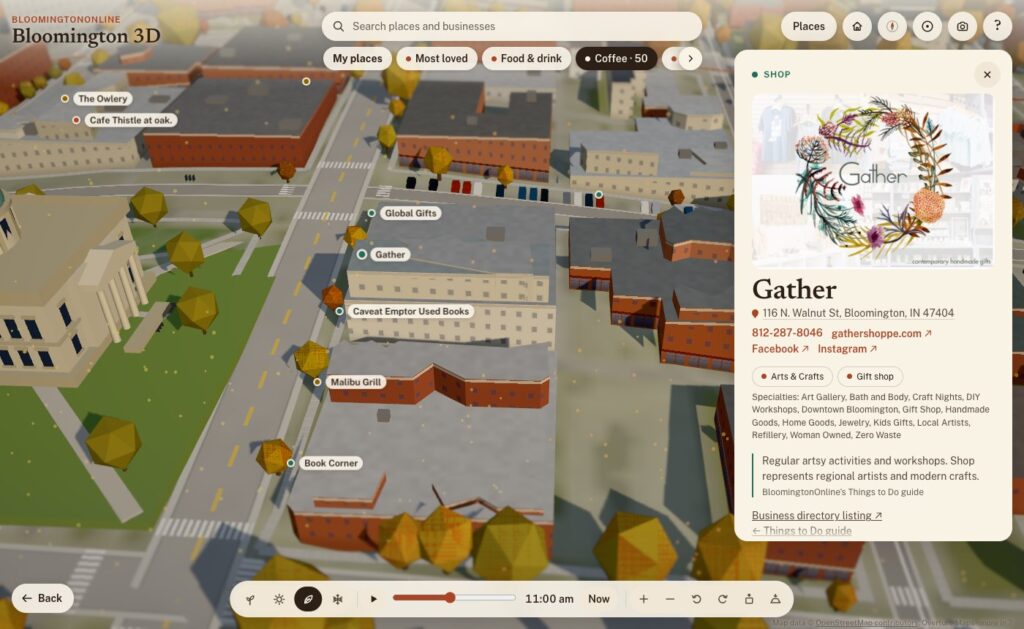
With the Coffee layer on, every coffee shop is a pin. Gather's card shows its photo, address, phone, website, social links and categories, live from the directory. Putting the directory on a map also showed us where the directory needed work. Over the years, several bulk imports had added some businesses two or three times. So we built a review page, went through every suspected duplicate, and merged 194 duplicate listings into the right ones. Nothing was lost: phone numbers, photos, categories and tags were combined, and every old address now redirects to the listing that stayed. The directory now warns us when a new listing looks like one we already have.
How it was built
I built Bloomington 3D with Claude Code, Anthropic’s AI coding agent, working as a two-person team: I set the direction, judged the results and knew the town, and Claude wrote the code, chased down the data and tested everything before it went live. Every feature went through the same loop:
- Ask. I’d describe what I wanted in plain words: “add Third Street too”, “the category selectors are being cut off”, “let’s make a camera icon for saving the view”.
- Build. Claude found the right data or wrote the code, often several pieces at once.
- Test. Every change was checked in a real browser, on desktop and phone sizes, before it shipped. That included flying the camera down the new fly-alongs and clicking through the new buttons.
- Ship. A one-command deploy publishes the new version to the site, keeping the old one for an instant rollback, and every change is saved in version control. As of this writing there are 146 of them.
A few principles held the whole way through:
- Facts first. Every claim on a place card traces back to a source on a fact sheet, and the copy was fact-checked twice. If something couldn’t be verified, it stayed out. That’s why the cards don’t say why the courthouse has a fish: nobody knows for sure.
- Open data, credited. Every source is credited on the map. There’s no paid mapping service, no API key, and no recurring cost.
- Private by default. Update, Oct 14: the map now uses anonymous Google Analytics to count what people tap, search for and share, so we can fix what is confusing. It collects no names or email addresses, and your saved places still stay on your own device. Tapping the heart on a business also runs a quick background check from Cloudflare (the same one our contact form uses). Your saved places stay on your own device.
- Works on a phone. The model picks a lighter quality level on phones, runs slower when nothing’s moving to save battery, and offers lighter graphics if things get choppy. It scores 100 for accessibility on Google’s Lighthouse test.
Two days, start to now
Day one (Sunday).
- Early afternoon: the first version, OpenStreetMap streets and buildings on terrain, with a tilt-shift look that makes it feel like a miniature.
- Next two hours: three art-direction passes, then night lighting, seasons, the guided tour, landmarks, boats, storefronts and performance tuning for phones.
- About 3 p.m.: it went live on the site.
- Next hour: the lidar heights, roof colors, real trees, city outlines, public art and the first directory integration.
- Evening: the Things to Do guide, the low fly-alongs, circling, directory pins on their buildings and category layers. It also got its name. It had started life as “Bloomington in miniature”, which I didn’t love.
Day two (Tuesday).
- Neighborhoods: from our own guide.
- Close-up detail: sidewalks, soft contact shadows, stepped roofs, ground detail and courthouse windows.
- Getting closer: low view and Street View links.
- Finding things: the search bar with category chips, and friendlier controls (Home, Back, double-tap to zoom, first-visit tips).
- Links and history: working browser Back and Forward, and shareable links that stay tidy.
- Directory features: richer business cards, My places, Locals love this, and pins for businesses just past the edge.
- Directory cleanup: the duplicate merge.
A lot of the best changes came from simply using it. On day one I noticed the business pins weren’t quite on their buildings. The directory’s locations were estimates from street address ranges, often 20 to 100 meters off, so we matched every listing to its actual building instead. Coming in from a directory listing, I noticed the address bar kept the old business’s name. The browser’s Back button didn’t walk back through places. The category chips were cut off on a phone. Each of those took minutes to fix once I’d noticed it.
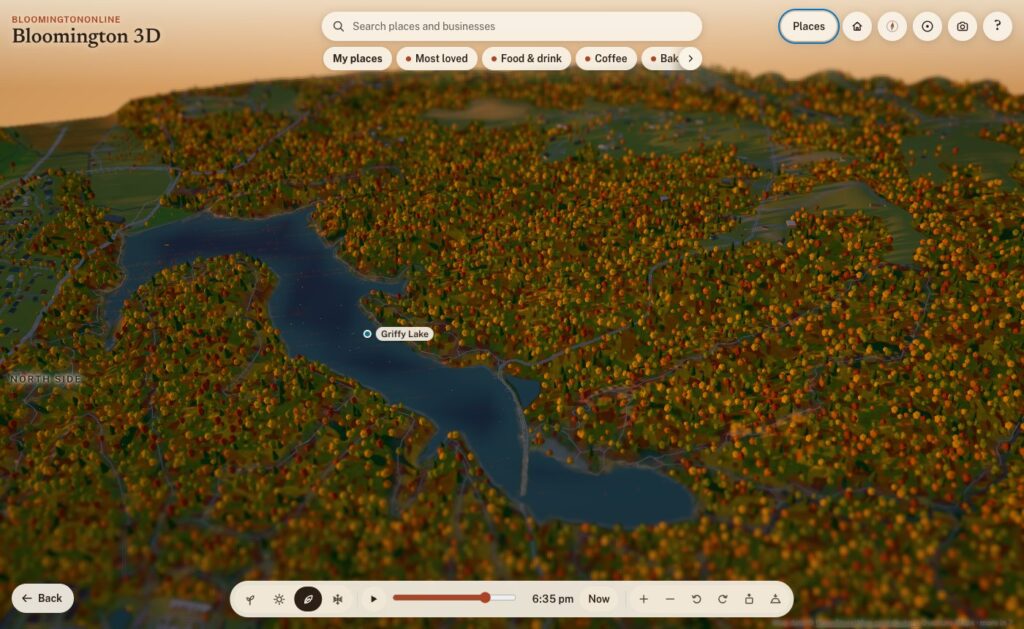
Griffy Lake at sunset in fall. Where it goes from here
After two days, Bloomington 3D includes:
- about 35,000 buildings and 36,000 real trees
- 50 written-up places, 67 Things to Do and 42 works of public art
- a dozen fly-alongs
- more than 1,900 businesses
- four seasons and a sun that keeps real time
It’s also a living thing, and that’s the exciting part. A few ideas on the list:
- a “show where I am” button
- events on the map
- live weather
- more guided tours drawn from our guides
- your saved places following you from device to device
But the best next steps will come from you. Take it for a spin, find your street, and save your favorite spots. Then tell us what you’d like to see, what’s missing, or what we got wrong. If a business is on the wrong building or out of date, use Flag this listing on its card. We read every one.
Map data: © OpenStreetMap contributors (ODbL); Overture Maps, including Microsoft building height estimates; USGS 3D Elevation Program lidar (Indiana Statewide 2017); IndianaMap 2025 imagery; City of Bloomington GIS; Indiana University campus tree inventory; AWS Terrain Tiles.
-
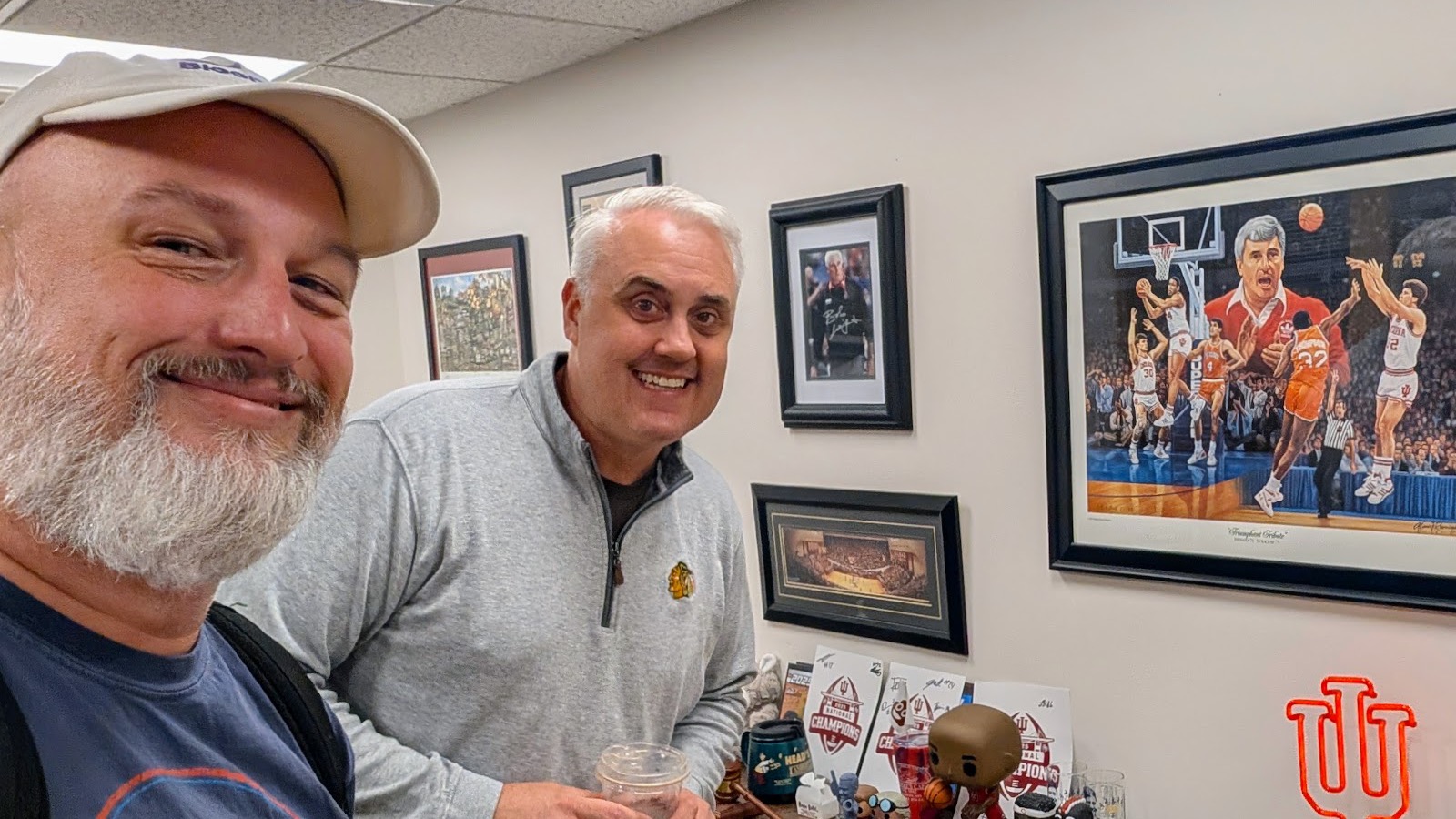
This morning I made a trip into the city to meet Andrew Lambert, the consultant behind Lambert Consulting and the host of the Mind Yo' Business podcast, and show him what I built on Bloomington Online over the last three days. He pulled up his own business listing in our directory. It was there, but it was nearly blank. This post is a thank-you to Andrew for the work he does in our community, and an account of how we fixed his listing and then rebuilt the south side of the Courthouse Square from a pile of photographs.
Andrew Lambert, in his own work
Andrew started his advertising agency in 2010 and launched the Mind Yo' Business podcast in 2017. Lambert Consulting helps owners with traditional marketing, digital advertising, websites and hosting, and one-to-one consulting. The podcast has run for nine seasons and is often recorded live in front of an audience at Morgenstern Books on South Auto Mall Road. Season 9 this year has included conversations with Brian Dorsey of Meineke Car Care Centers, the team at Brightside Cafe, Jordan Davis on food and festivals in Bloomington, and Kaytee Lorentzen on the Chamber of Commerce.
The Greater Bloomington Chamber of Commerce profiled him in April as part of its Small Business Series. It describes a former professor and stand-up comedian who wanted interviews to feel like a real conversation, with very few scripted questions and room for the mistakes and pivots that most people leave out. His idea of being "selflessly selfish" is that you can chase your own success as long as you create value for the people around you, and his advice to people starting out is to be real, stay flexible and take action.
He also gives back. On his own site Andrew says he served as Marketing Director and then President of the Monroe County Autism Foundation, founded in 2011, and as an advisor and contributor to the Katie and Victor Root New Hope Scholarship at Ivy Tech Community College, which helps adult learners return to school. He is the author of Be the Lime: An Insider's Guide to College.
If you own a business in Bloomington and you haven't heard the show, start with the episodes. If you need help with your marketing or your website, he is a good person to call.

Andrew's listing in the Bloomington Online directory today. The blank listing
When Andrew looked himself up in our directory, he found a one-line placeholder that had been generated automatically when the directory was first filled in. That is the kind of thing I have been cleaning up all week, and it was a good reminder of how many businesses are in the same position. So we fixed it. I opened Claude Code in the Terminal, told it whose listing to improve, and it read his website and the sources about him, then wrote the description, added his logo, set the categories and tags, and corrected his website address. Every sentence in it traces to something he or a reputable source has published, and the old text is backed up. His podcast's listing, which was also a placeholder, was rewritten the same way and moved to the media category where it belongs.
That is the whole method. I describe the job in plain English, the assistant does the research and the typing, and I decide what goes on the site. A written note, a link, or a photograph is enough to get it started.
From eighteen photographs to a courthouse
The part of the demonstration I enjoyed most was the photographs. The previous version of the courthouse in Bloomington 3D had a copper-green dome and a front with steps up to the doors. It was a fair miniature, but it was a guess. So I walked around the Courthouse Square and took eighteen photos: the south front, the stairs, the flower beds, the plaques, the stores across Kirkwood Avenue, and the fish on top. I gave them to Claude Code and asked it to make the model match.
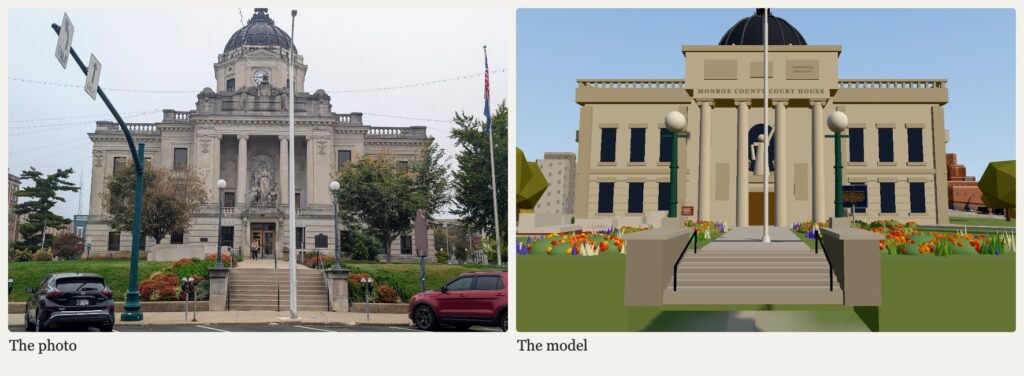
The south front of the courthouse, in my photo and in Bloomington 3D. The photos corrected the model right away. The real courthouse has no steps at its doors. The long flight of stone steps with cheek walls and green lamp posts is down at the street, and a concrete walk crosses the lawn from there. The dome is dark and ribbed, with a clock on each face of the tower and an ornate crown at the top. The model now follows all of that, along with the lettering on the building, the "Anno Domini" panel, and the group of limestone figures over the entrance.
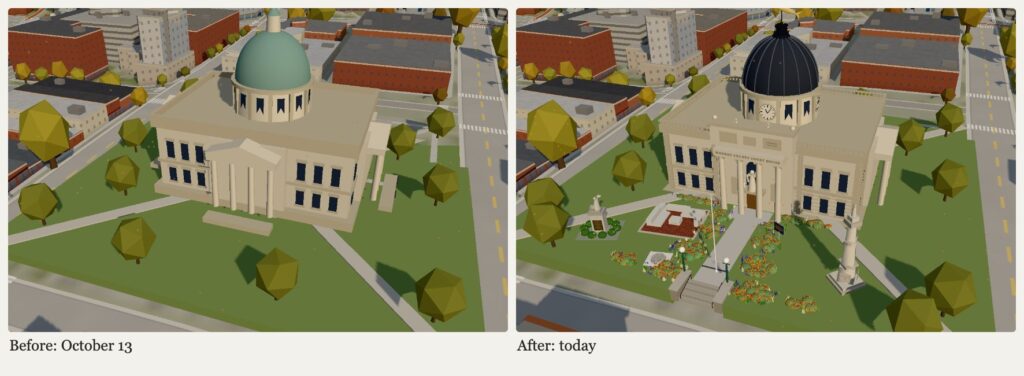
The Courthouse Square before and after. The details on the lawn
The photos also showed what is on the lawn, and all of it is in the map now. A state historical marker stands beside the walk with its text about the 1818 log cabin and the brick courthouse that stood here until 1906. There is the Women in Government Plaza, with its stone benches and the block carved "Sophia," and a stone marking the Center of Population. A limestone memorial to county commissioner Warren Henegar, dedicated in 2013, carries its plaque and the words "Make me an instrument of Your peace." A tall war memorial topped by a soldier stands on the south lawn. The beds along the walk are full of orange and red flowers with blue salvia.
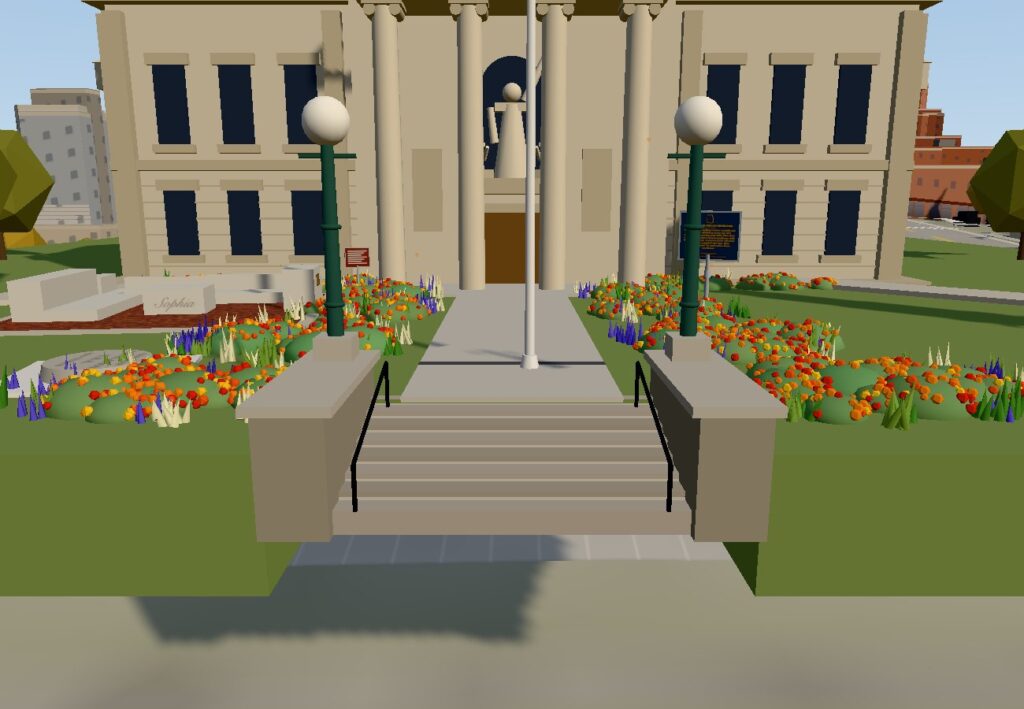
The steps at Kirkwood Avenue, with the lamp posts, rails and flower beds. And the fish. Its weathervane is a long slim fish with a forked tail on a pole with four arrow-tipped arms, and the dome beneath it ends in a crown of leaves and scrolls. The old model had a plump fish on a lantern, so we rebuilt it. The fish swings slowly on its pole, as a weathervane should.
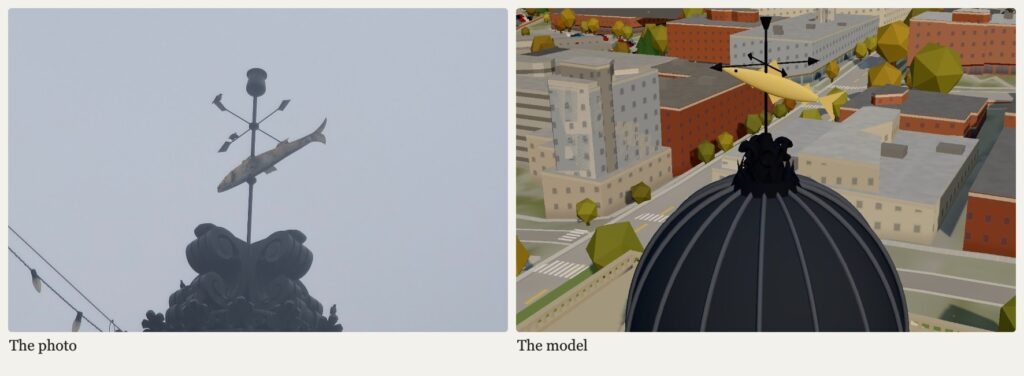
The weathervane on top of the courthouse, in my photo and in the model. Across Kirkwood Avenue
The storefronts were next. The old map had a single long brick building across from the courthouse. In reality it is six, each with its own color and character, so each one got its own front: the white building with blue-trimmed arched windows and the cream one beside it over Andrew Davis menswear and formalwear, a narrow red-brick building, the cream building with the teal cornice over Mirth and its "Browse the shops inside" sign, the tall limestone Fountain Square building with its black awning, O'Child and #skullznbunniez, and the limestone building with the oriel windows over Tivoli Fashions.
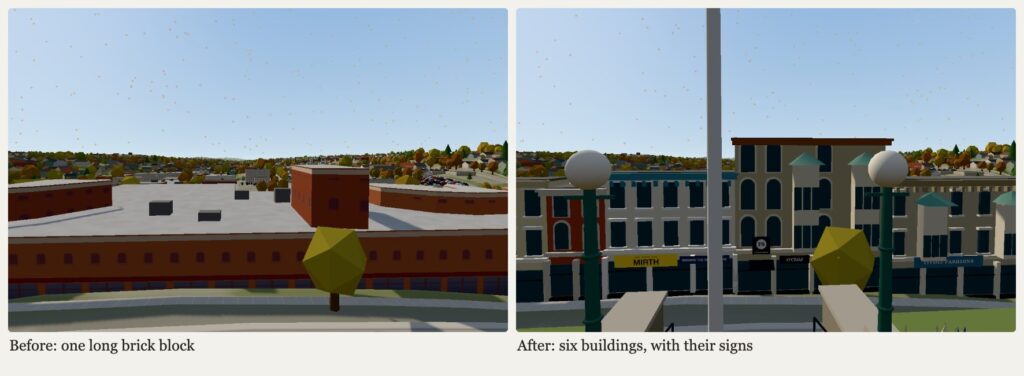
The stores across Kirkwood Avenue before and after. These are still miniatures. The shapes and colors come from photographs taken from the lawn, so they are close but not exact, and the buildings along the rest of the Square are next.
How it works, in case you want to try it
- I take photographs or write down what I want, and I put them in the Terminal where Claude Code is running.
- It reads them, writes the code or the listing, and renders the result in a browser so it can check its own work.
- I look at what it made, point out what's wrong, and it fixes it. Every change has a backup, so anything can be undone.
- The listings follow a rule: no fact goes in unless it comes from a source I can point to.
AI makes mistakes, and today's first attempt put steps at the courthouse doors because that seemed reasonable. Photographs are what fixed it, and they are what I'd ask you for if you'd like your own business or building to look right on the map.
Visit, and say hello
Open Bloomington 3D and walk up to the courthouse from Kirkwood Avenue. Then look up Lambert Consulting and the Mind Yo' Business podcast in the directory. If you own a business, make sure your listing is correct. If it is not in the directory yet, let me know and I will add it. Thank you, Andrew, for the time and for the good work you do for Bloomington.
-
Yesterday we told you how Bloomington 3D came together in two days. Today was about everything behind it: the business directory. We rewrote hundreds of listings from sourced facts, rebuilt the category system so businesses are where you would look for them, added a way to see what is popular, and tuned the map so it follows the new categories. Here is what changed and why.
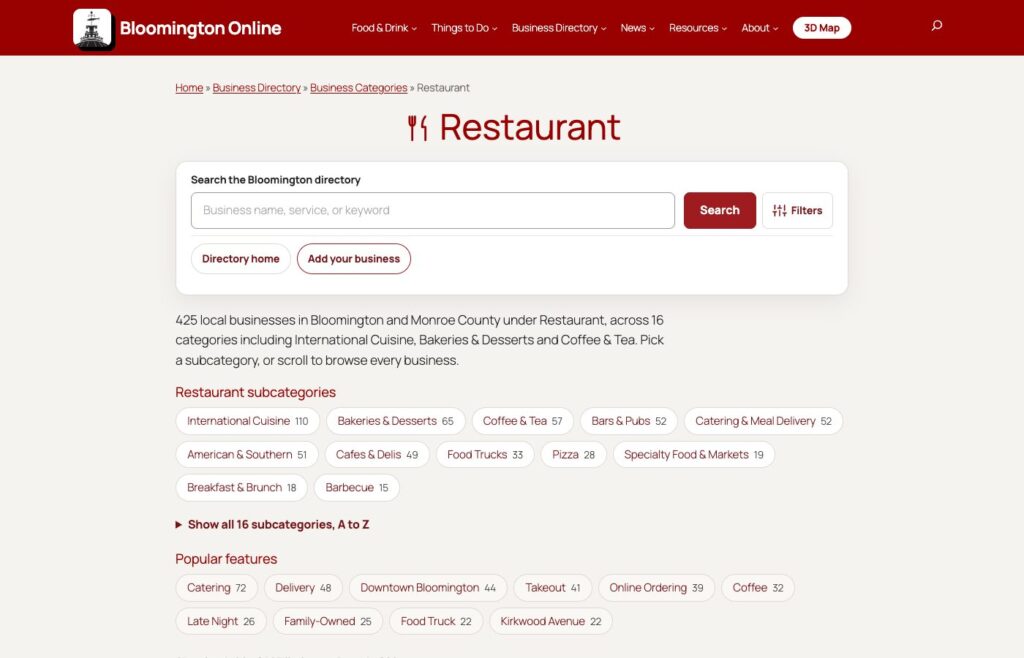
The Restaurant page now has 16 clear groups, with a count of businesses in each. Why we started with the directory
Bloomington 3D shows every business in our directory on its building. That made the weak spots obvious. Many listings had a one-line description copied from an import. Some businesses had closed. Some websites had been taken over by spam. And the same restaurant could sit in four overlapping categories, so you could not tell where to look for pizza, or sushi, or a coffee shop that also bakes.
So today we did a cleanup, in four parts.
1. Food listings, rewritten from sources
The food and drink listings came first. For each of the 480 listings, we researched the business from its own website, its social pages, local news and guides. Then we wrote a new short description and a fuller write-up, fixed the categories, and added photos and logos where we could find them.
One rule made this safe: every fact in a description had to come with a source link and the exact words from that page, and a script then re-opened each page to confirm the words were really there. A sentence that could not be confirmed stayed out. If a business could not be confirmed as open, we did not rewrite it.
The result: more than 250 listings were rewritten and are live. The ones we could not verify were held back and reviewed one by one. About fifty listings that were closed, duplicated or not really in Bloomington were removed or merged, and every old web address for a merged listing now sends you to the one that is left. We also cleared the website link on a handful of listings where the old site had been taken over by an unrelated spam or gambling page.
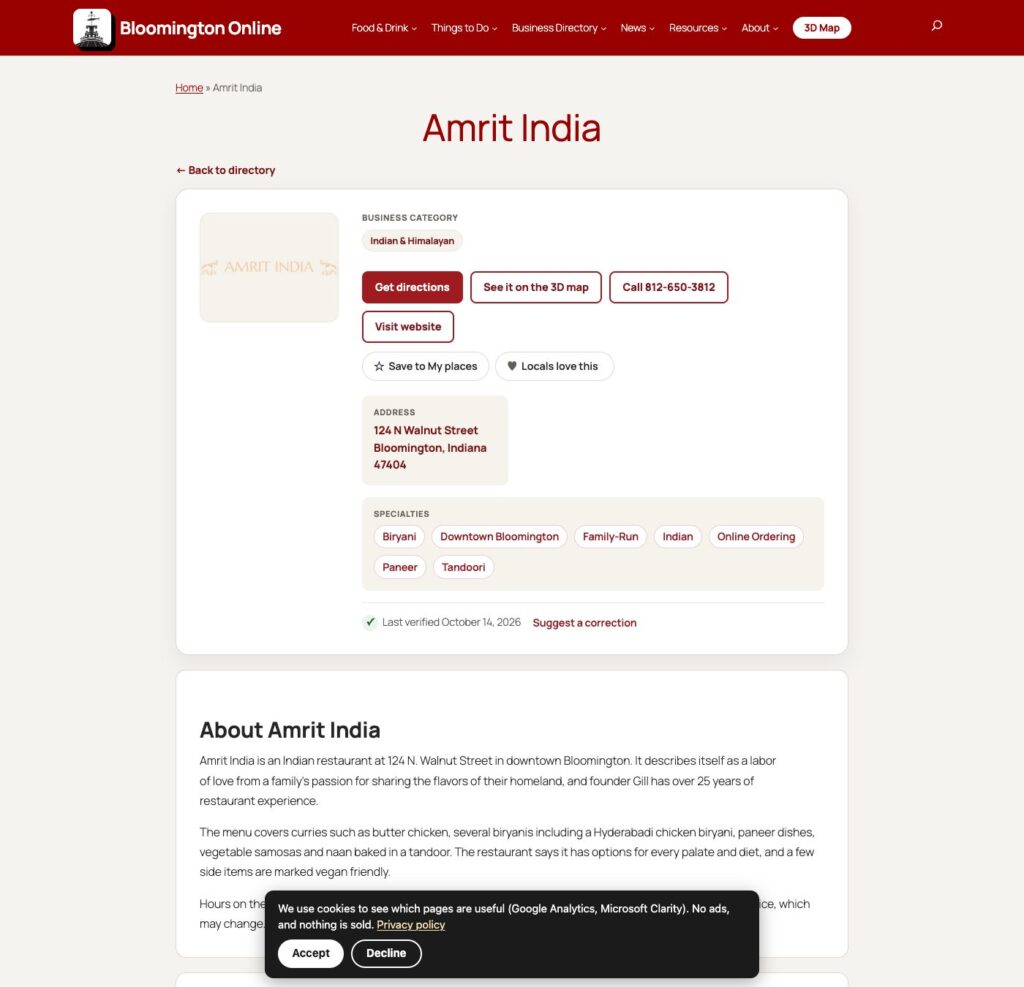
A rewritten listing: cuisine category, directions, the 3D map, specialties as tags, and the date it was last verified. 2. Categories that make sense
Under Restaurant there were 48 overlapping subcategories. We looked at how Visit Bloomington groups dining, how Yelp splits food from nightlife, and how our own listings had been tagged by several imports over the years. Then we reorganized: 16 groups, including American & Southern, Barbecue, Pizza, Breakfast & Brunch, Bakeries & Desserts, Coffee & Tea, Bars & Pubs, Breweries, Food Trucks, and one International Cuisine group that holds eight cuisines from Mexican and Latin American to Japanese & sushi.
Then we did the same for everything else. The non-food categories went from about 313 to about 145, grouped under nine sections. The big catch-all, Professional Services, held 275 listings from a single import, with banks, law firms, insurance agents and car dealers all mixed together. They now sit in their own categories. More than 700 listings moved to a better home, and the number of listings with no category at all dropped from 141 to 26.
Tags got the same treatment. There were about 2,500, and most were used once, or just repeated the category name. We cut them to about 1,400 and fixed the capitalization.
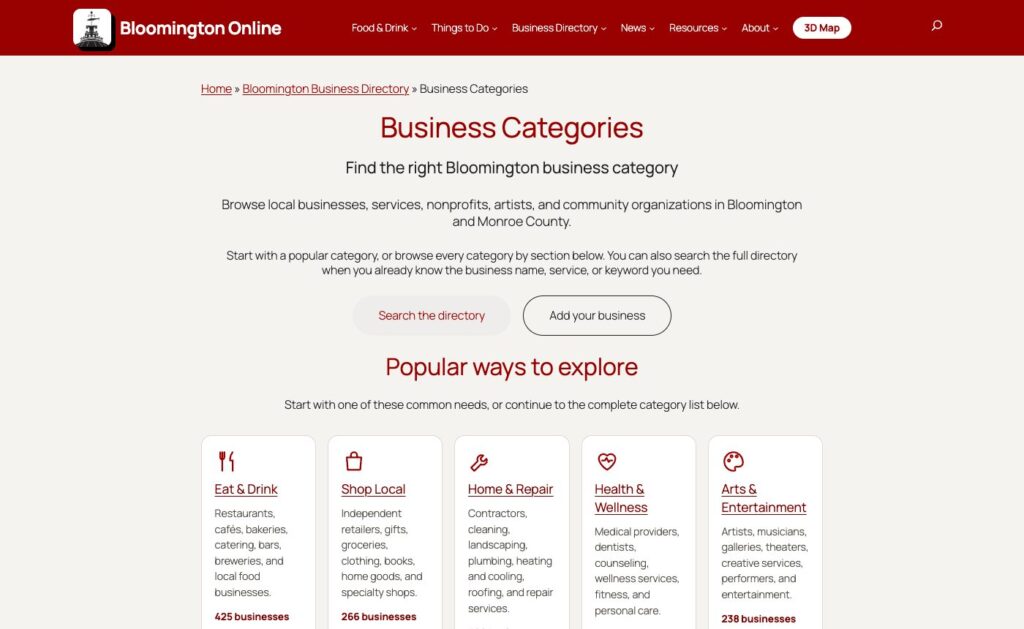
The categories page lists every category by section, with live counts. 3. Category pages that help you choose
The category pages got a redesign too. Each now opens with a plain sentence about what is in it, subcategory chips, related categories and popular features such as Takeout, Online Ordering or Family-Owned. You can sort by A to Z, most viewed or recently verified, and long lists scroll without page buttons. A button on every category opens just those businesses on the 3D map.
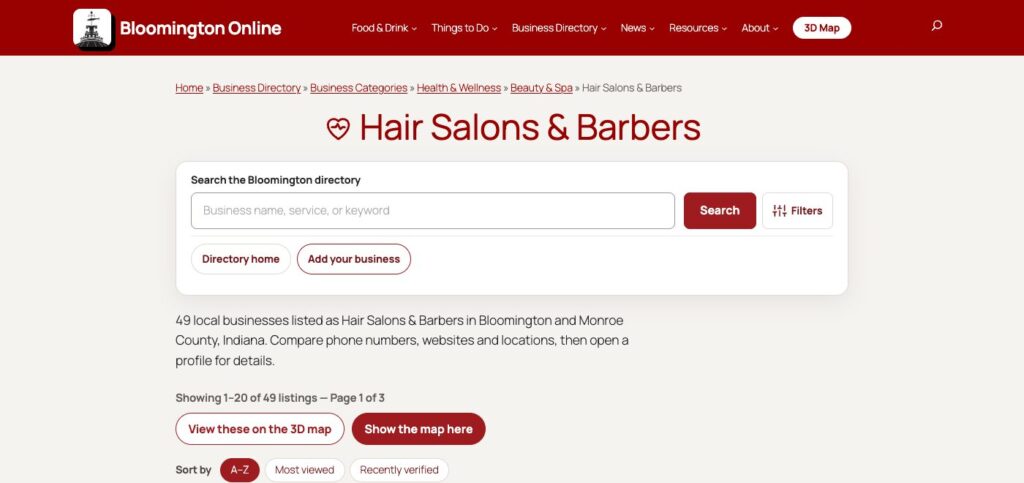
A category page with search, a count of businesses, sorting, and buttons for the 3D map. 4. What people love, and what is new
The footer now shows Most Loved Businesses and the newest businesses side by side, each with a photo or logo and its category, so a visit can start with what other people like. Listing cards also show a small visits count once a business has been looked at enough times for the number to mean something. Business owners get a traffic panel on their own listing that nobody else sees.
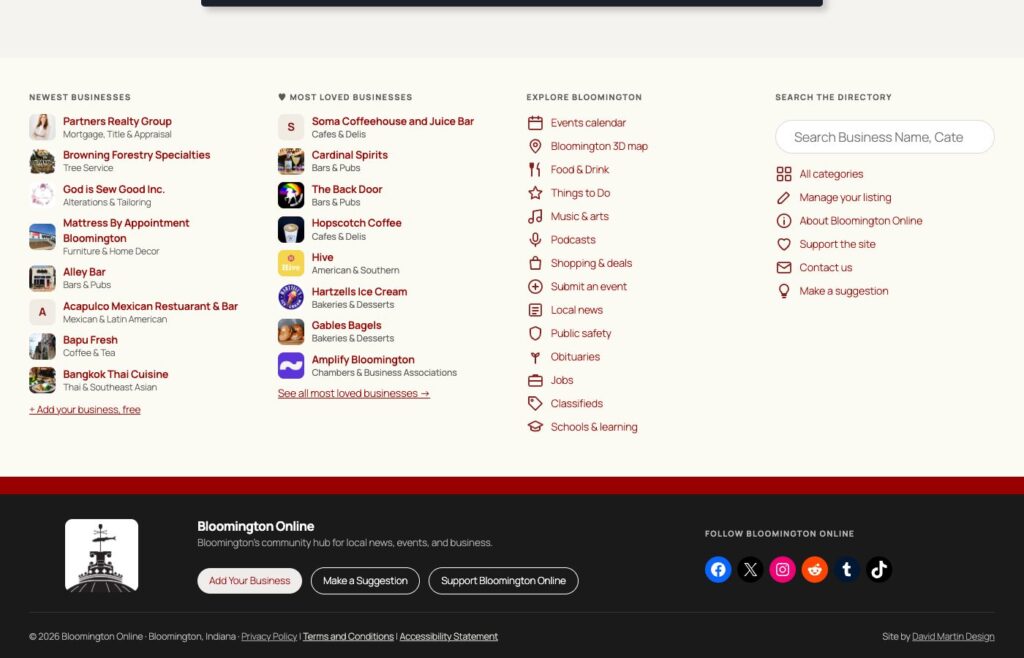
The new footer: newest businesses, most loved businesses, and links to explore Bloomington. 5. The map follows the new categories
The 3D map groups its businesses by category, so we updated it to match. The chips along the top, such as Bars & pubs, Japanese & sushi, Bakeries & desserts, Coffee, Pizza, Breweries and Food trucks, now follow the reorganized food categories. Tap one and the pins and a list appear. The search box also finds businesses by tag and category and shows the short description on each card.
A few other things landed on the map today:
- A Show where I am button, so you can find yourself in town. It uses your location only on your own device while you press it.
- Specials today: daily food and drink specials from a calendar we keep of Bloomington bars and restaurants.
- An Edible trees layer, built from the City and IU tree inventories after a reader pointed us to a community map of fruit and nut trees.
- Most loved lists, and hearts and stars on directory cards. Votes are checked by Cloudflare Turnstile so one person cannot pile on, but it stays easy to love your favorites.
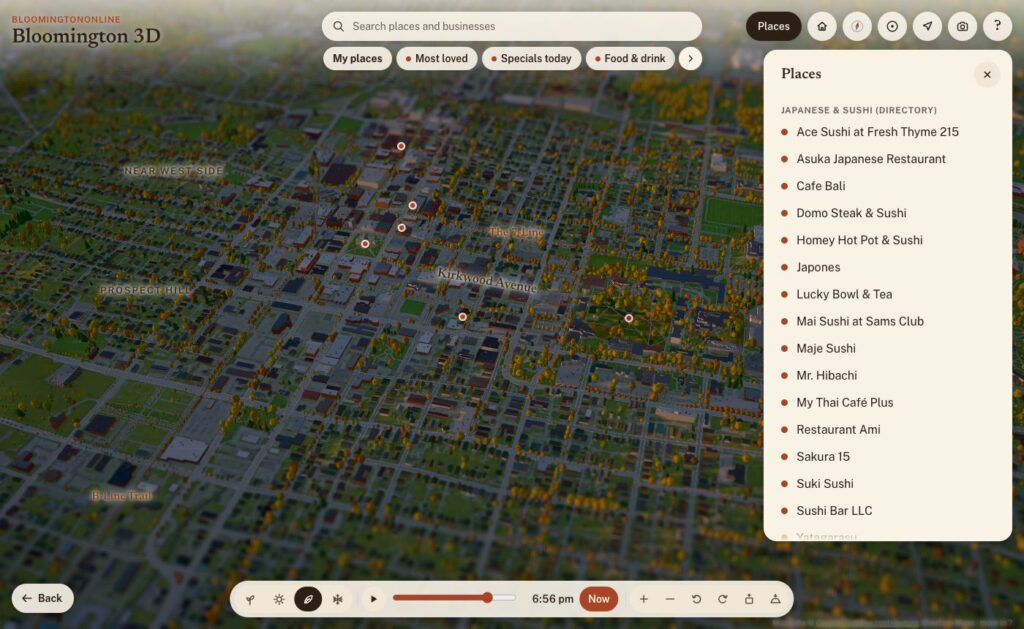
Tap a category chip and the matching businesses appear on the map and in a list. 6. Behind the scenes
Some of the work does not show on the page, but it is what makes the site findable.
- Search engines now get specific labels. A dentist is marked as a dentist and a hotel as a hotel, and the directory keeps those labels working after the category renames.
- Old addresses are redirected. Merged categories and tags, retired listings and old pages now send you to the closest live page instead of a dead end.
- Pages are faster. Google’s Lighthouse test scores the home page 98 for performance on a phone, up from the 70s and 80s, and 95 to 97 for accessibility.
- The new compact header puts a 3D Map button in the main menu.
We also added anonymous usage statistics to the map today, and this changes something we said yesterday. Bloomington 3D now uses Google Analytics to count what people tap, search for and share, so we can fix what is confusing and build what people use. It does not collect names or email addresses, and your saved places still stay on your own device. Our privacy policy explains how analytics are used.
The statistics already taught us something: about half of last month’s page views on the site were not people. They were automated bots, mostly in two short spikes in September. Knowing that makes every other number more honest.
How it was made
Like yesterday, this was a collaboration with AI. Several Claude Code agents worked side by side: one researching businesses, one reorganizing categories, one on the page design, one on analytics and redirects. Every change was saved with a backup first so that anything could be undone, and a person made the calls on anything uncertain. We got some things wrong along the way. The first time we nested the old categories under the ten top-level sections, we filed Aviation under Fitness. A day of looking at the live pages caught it, and it is fixed.
What is next
- Researching the listings we could not verify yet, and finishing the last unclassified restaurants.
- A short email digest of what is new and what is happening in town.
- A way for business owners to claim and complete their own listing.
- More of the 3D map: events, live weather and more guided tours.
Take a look around. Browse the new categories, open the map, and love a few favorites. If something is out of date or in the wrong place, use Flag this listing on any business card, or tell us. We read every one.
-
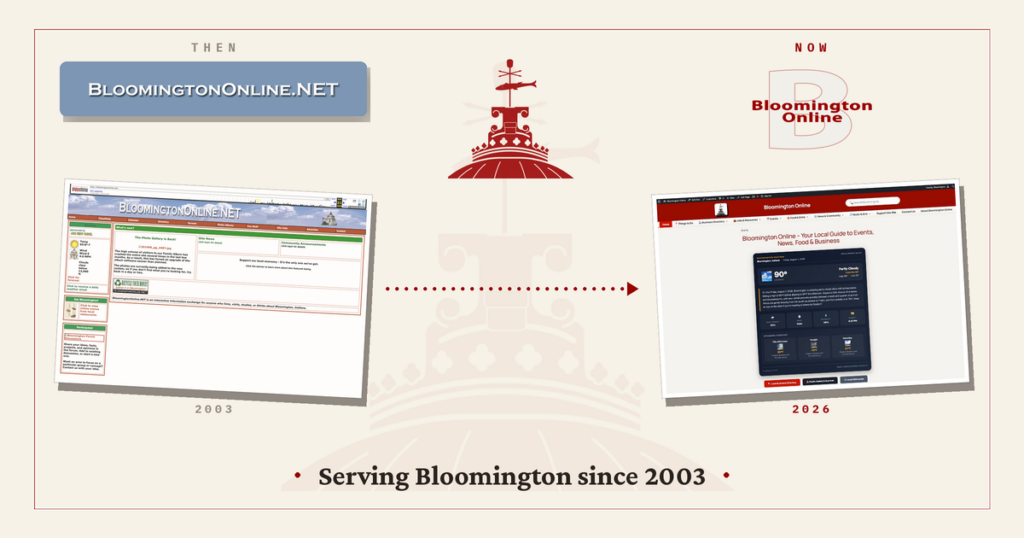
Bloomington Online has been a quiet fixture of local life for more than twenty years. Lately it has been growing again, so this feels like a good moment to look back at how it started, share what we have been building, and talk about where we hope to take it. If you want the fuller story, our new About page covers it too.
Where it started
Bloomington Online has been part of the local web since 2003. For much of that time it was the work of one person, Dale Staton, who built it by hand into something impressive and technically complex.
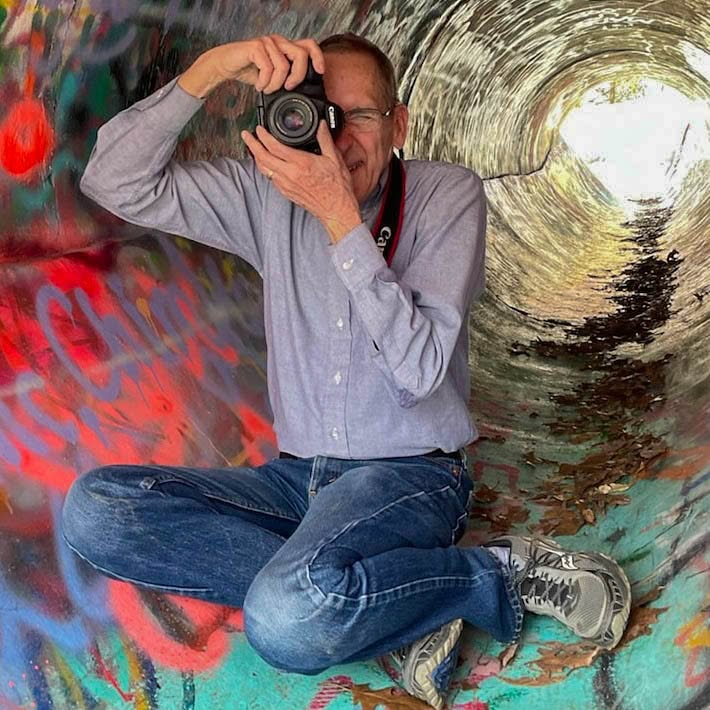
Dale Staton built Bloomington Online and spent years documenting Bloomington through his camera.
Dale put himself into the site the way he put himself into everything he cared about: photography, staying close to people, and showing up at community events all over town. When the time came to pass it on, we met at a local Starbucks and he walked through everything he had made. It was remarkable, and we were glad to help keep it alive and growing.
Where we are today
Over the past year we rebuilt Bloomington Online on a modern platform and added a lot to it. A few of the pieces you can explore right now:
- A searchable business directory of local businesses, nonprofits, and community groups, with an easy way to add your own listing.
- A local news hub that gathers headlines from trusted local and state sources, so you can catch up in one place.
- An events calendar where anyone can submit an event.
- A growing food and dining guide, with featured local restaurants, hidden gems, farm to table spots, and international row.
- Things to do, local music, and community photo galleries.
- Practical resources like local jobs, obituaries, and public safety information.
The goal behind all of it is simple. Give residents a reliable home base for local life, and give local organizations a place to be found.
Update, October 2026: we’ve added Bloomington 3D, an explorable 3D model of the town with every business in the directory on its building. Read how we built it.
What we hope to accomplish
We want Bloomington Online to keep getting more useful, and more local, over time. Some of what we are working toward:
- Growing the directory so more of Bloomington’s businesses and nonprofits are represented.
- Keeping local news and events current and easy to scan.
- Adding more community photos, stories, and resources.
- Welcoming neighbors who want to help, whether that is sharing an event, suggesting a listing, or lending a hand.
We would also love your input on what would make the site more valuable to you. You can always make a suggestion.
A community effort
Bloomington Online is community supported. It is not a nonprofit, so contributions are not tax deductible, but they are what keep it running: hosting, upkeep, and the news aggregation that keeps headlines flowing. If the site is useful to you, you can help keep it going on our support page.
More than anything, this is a thank you. To Dale, for building something worth carrying forward. And to everyone in Bloomington who uses the site, adds to it, and helps it grow.
-

A confirmed tornado touched down in Bloomington, Indiana on the night of February 19, 2026, carving a path of destruction across the west side of the city and into residential neighborhoods including Fieldstone and Stonechase. No fatalities have been reported, but property damage is extensive.
The storm moved through with sustained winds exceeding 60 miles per hour. In the Fieldstone neighborhood, entire roofs were lifted from homes, gutters and siding were stripped, trees were damaged, and outdoor furniture was scattered across yards. Debris was reported throughout the area, and the damage extended well beyond individual streets.
This reporter and family are among those affected. While our family is safe, we sustained roof and gutter damage, a downed backyard tree, and lost outdoor furniture. Our neighbor’s home was among the hardest hit on our street, with their roof completely gone and garage door destroyed.

A neighbor’s home in Bloomington’s Fieldstone neighborhood shows the aftermath of a tornado that struck the west side of the city on the night of February 19, 2026. The roof is missing and the garage door was completely destroyed. Photo: Dave Martin / BloomingtonOnline.com Fifth Third Bank and Commercial Damage
Among the most visually dramatic damage was to the Fifth Third Bank branch off Third Street near I-69, where the roof was entirely stripped from the building, exposing the structural framing. The drive-through canopy was heavily damaged and debris was scattered across the parking lot. Storm Track 8 Meteorologist Drew Narsutis, reporting from Bloomington, confirmed the bank as one of the hardest-hit commercial structures from the evening’s storm.
See Jeremy Hogan’s photos on Facebook from The Bloomingtonian
Monroe County Humane Association Hit Hard
The Monroe County Humane Association (MCHA) campus also took a direct hit. In a statement released overnight, Executive Director Andrew Krebbs confirmed significant structural damage to the facility and the total loss of a storage building containing the organization’s food and supply inventory. All animals were safely evacuated and relocated to trusted care partners including Animal Care and Control and The Ranch Cat Rescue.
“To the community, we’ll need you once we assess next steps. Please avoid our campus for now, as it’s unlikely usable in the near future.”— Andrew Krebbs, Executive Director, Monroe County Humane Association
Krebbs also thanked Shane and Scott from Electrical Services, Police Chief Diekhoff and the Bloomington Police Department for helping secure medical supplies, and the many community members who reached out overnight.
⚠️ Please avoid the MCHA campus. If you have an upcoming appointment, MCHA will contact you proactively in the coming days. Physical donations cannot be accepted at this time — follow their official Facebook page for updates on how to help.
Stonechase Neighborhood Near the Airport
The Stonechase neighborhood, located near the Monroe County Airport, also sustained significant damage. Reports from residents and storm spotters describe windows blown in, walls cracked, siding stripped, and interior debris. Meteorologist Todd Klaassen noted the damage was consistent with the radar rotation he had been tracking as the storm moved through.
Monroe County Airport
Unconfirmed reports from community members describe significant damage at the Monroe County Airport, including hangar doors blown completely off, aircraft dragged across the tarmac, and private jets and vintage vehicles reportedly destroyed or overturned.
Lightning Over Rose Hill Cemetery
The Bloomingtonian captured dramatic images of lightning streaking across the sky over Rose Hill Cemetery as severe storms moved through the area, underscoring the intensity of the weather system that preceded and accompanied the tornado.
📷 See the photo on FacebookCommunity Response
As word spread overnight, Bloomington’s community response mobilized quickly. Volunteers, licensed electricians, animal care workers, and organizations from as far as Indianapolis and Lafayette offered assistance. Stephanie Miller offered a large building as a potential temporary shelter for MCHA animals. Hal E. Kae indicated a volunteer team from Indianapolis-based PAAW could be deployed.
The outpouring reflects what Bloomington does best — showing up for neighbors when it matters most.
What to Do Now
If your property was damaged, document everything thoroughly with photos and video before cleanup begins, and contact your insurance provider as soon as possible. Monroe County Emergency Management is the primary point of contact for disaster assistance resources. Avoid damaged structures, downed power lines, and debris-filled roads until they are cleared and assessed.
BloomingtonOnline.com will continue updating this story as more information becomes available. If you have photos, video, or damage reports to share, contact us directly.
Media credits: Original video and photography by Dave Martin / BloomingtonOnline.com. Please share original posts directly where possible.
Sources: MCHA Executive Director Andrew Krebbs (official statement), Storm Track 8 / WISH-TV Meteorologist Drew Narsutis, Meteorologist Todd Klaassen, The Bloomingtonian, community reports via Facebook.
-

Bloomington is a college town, and that means a lot of bars built around IU students — packed on game nights, overrun during Little 500, and half-empty every summer. But tucked between the beer-pong specials and the themed bar crawls, there’s another Bloomington bar scene entirely: the townie circuit.
These are the places where the bartender knows your name, the drinks are priced for people who live here on a real salary, and nobody’s wearing a jersey. Whether you’re a longtime local or just someone who prefers conversation over cover charges, this list is for you.
Want to see where they are? Every bar in our directory is on the Bloomington 3D map.
1. Alley Bar
Location: 210 W Kirkwood Ave
Vibe: Classic Dive
Website: alleybarbloomington.comIf there’s one bar in Bloomington that earns the “townie” label without qualification, it’s the Alley Bar. Tucked just off the Kirkwood strip, it manages the rare trick of being right in the middle of everything while feeling entirely removed from the college bar scene. Bartenders know their regulars, prices are genuinely cheap, and the vibe is low-key without being unwelcoming to new faces.
“Great little locals bar, not a college bar for the most part. Bartenders friendly and the locals are accepting of outsiders as well.”
- Open until 3 AM
- Cheap drinks
- Sports-friendly atmosphere
2. The Bishop Bar
Location: 123 S Walnut St
Vibe: Dark & Literary
Website: thebishopbar.comNo TVs. No blaring music. Just a dark, well-curated bar with knowledgeable bartenders and a clientele that actually wants to have a conversation. The Bishop is the kind of place where you discuss local politics, argue about books, and somehow end up staying three hours longer than you planned. The beer and spirits selection punches well above its weight for a small Bloomington bar.
“If your idea of the perfect bar conversation involves The Clash playing in the background, this may be your favorite bar in Bloomington. It is mine.”
- Excellent jukebox selection
- Curated beer and spirits
- No TVs — conversation-focused
3. Video Saloon
Location: 105 W 7th St
Vibe: Arcade BarThe Vid is a Bloomington institution. Arcade games, pinball machines, cheap pitchers, and a dim, comfortable atmosphere that feels like it hasn’t tried too hard in a good long while. It draws a mix of students and long-timers, but the culture is firmly rooted in locals who’ve been coming here for years. A perfect Tuesday-night bar.
- Classic arcade games and pinball
- Cheap pitchers
- Open until 3 AM
4. Sleeper’s Bar
Location: 2601 N Walnut St
Vibe: Hidden Gem
Website: sleepersbarbloomington.comUp on North Walnut, well away from the student strip, Sleeper’s is one of those owner-operated neighborhood bars that Bloomington is lucky to have. The owner is behind the bar most nights, making genuinely excellent cocktails in an intimate, nicely decorated space. It’s the kind of place you want to keep to yourself — which explains its perfect five-star average.
“It’s located away from all of the craziness with IU bars, putting it in an ideal spot. The drinks are also very reasonably priced.”
- Excellent craft cocktails
- Owner-operated
- Perfect 5.0 rating
5. Hoppy Wobbles Pub
Location: 3876 W 3rd St
Vibe: Neighborhood Pub
Website: hoppywobbles.comOut on the west side, Hoppy Wobbles is a proper neighborhood pub — the kind of spot where regulars know each other and the owner greets you by name. The tap list rotates frequently with well-chosen craft beers, they allow outside food (yes, really — order a pizza and bring it in), and Wednesday trivia night draws a loyal crowd. If you live on the west side, this is your local.
“The owner was very informative about the craft beers. Really enjoyed our time there. We’ll be back when in the area!”
- Rotating craft beer selection
- BYOF (bring your own food) welcome
- Wednesday trivia nights
6. The Sinkhole Craft Beer Bar
Location: 313 E Winslow Rd
Vibe: South Side Local
Website: thesinkhole.beerDown on the south side — about as far from campus as you can get and still be in Bloomington — the Sinkhole is a small, unpretentious craft beer bar with the feel of a true regular’s place. The staff knows their beer, the owner introduces himself and shakes your hand, and on Saturday nights there’s live jazz from 8–10 PM. Free popcorn seals the deal.
“More of a ‘regular’ type place. The owner/bartender introduced himself with a handshake and asked my name, and then remembered it.”
- Live jazz on Saturday nights (8–10 PM)
- Free popcorn
- Knowledgeable craft beer staff
7. Atlas Ballroom
Location: 209 S College Ave
Vibe: Eclectic Hangout
Website: theatlasballroom.comAtlas Ballroom occupies a wonderfully strange niche in Bloomington’s bar scene — eclectic decor that surprises you on every visit, a vintage photo booth, skee-ball, and an evolving cocktail menu. It’s downtown but has a decidedly local personality. The kind of bar that people who’ve left Bloomington miss specifically by name.
- Vintage photo booth
- Skee-ball
- Open until 3 AM
8. The Bluebird
Location: 216 N Walnut St
Vibe: Live Music Venue
Website: thebluebird.wsThe Bluebird isn’t a dive bar — it’s a legitimate live music institution that’s hosted memorable acts for decades. But it belongs on this list because it’s the kind of place that belongs to Bloomington rather than to Indiana University. The walls are covered in photographs of bands who’ve played here. Three bars keep lines short. If a good band is in town, this is where they’re playing.
“Rich in history. Photos with dates on the walls of bands and singers that have played there over several decades. Not a fancy place but definitely my kind of place.”
- Live music almost every night
- Three full bars
- Decades of Bloomington music history
9. Kilroy’s Sports Bar
Location: 319 N Walnut St
Vibe: Sports Bar
Website: kilroyssports.comKilroy’s has been part of Bloomington long enough that it has genuine townie credibility, even if it skews toward a mixed crowd on big nights. It’s been ranked among the best college sports bars in the country, hosts live music in the Atrium, and Thursday trivia draws a loyal local following. Multiple floors, lots of screens, and a long history that makes it feel like a real Bloomington landmark.
- Wall-to-wall TVs for sports
- Live music venue (The Atrium)
- Thursday trivia nights
Special Mention: The Office Lounge
Location: 3900 E 3rd St
Vibe: Karaoke, Food, & Quarter Pool
Website: View on Google MapsThe Office Lounge deserves its own special call-out. When locals think about karaoke in Bloomington, the Office is one of the first places that comes to mind. Add in legitimately good food, quarter pool tables, and a neighborhood dive bar atmosphere, and you’ve got a spot that’s made plenty of Bloomington memories over the years.
It’s a no-frills place that’s been a staple for decades — the kind of bar where you can grab a solid burger, sing your heart out, and sink a few balls on the pool table without spending a fortune. The parking lot is always full for good reason.
- Karaoke nights
- Quarter pool tables
- Good, affordable food
- Open 9 AM–3 AM most days
A Word on the Bloomington Bar Scene
Every bar on this list has a personality beyond the student rush — but Bloomington is still a college town, and that context never fully disappears. The spots farthest from campus (Hoppy Wobbles on the west side, the Sinkhole on the south side, the Office Lounge on the east side, and Sleeper’s up on North Walnut) tend to stay the most consistently local year-round.
The best time to experience any of these bars as a true townie haunt? Any Tuesday or Wednesday night outside of the academic year. The regulars will be at the bar, the bartenders will have time to talk, and Bloomington will feel exactly like the small, interesting, unpretentious city it actually is.
About This Guide
This guide was inspired by a conversation with Kaytee Lorentzen and Dave Martin about the best karaoke spots in Bloomington. Thanks for the inspiration!
Know a townie bar we missed? Drop us a line and we’ll check it out for the next update.
-
A Generational Gift of Nature and Stewardship
Monroe County has just taken a major step toward preserving natural beauty for future generations—thanks to a remarkable donation from the trust of Nancy Huntington, 409 acres on the southeast side of Bloomington will become the site of a brand-new county park.
📍 The land sits near E Moores Pike, S Smith Rd, and SR-446, and will be protected for recreational and nature-based uses only—no non-recreational development will be allowed.
County leaders say plans are still in the works, but trails for hiking, walking, and biking are already envisioned, along with a deep commitment to protecting the site’s ecological value in the Monroe Lake basin.
🗣️ What Local Leaders Are Saying
“Not often do we have this historic opportunity to ensure over 400 acres are set aside from development to be cherished by future generations,”
— Julie Thomas, President, Monroe County Board of Commissioners“This park represents a commitment to the history, people, and natural environment of Monroe County,”
— Julie Thomas“This natural area will provide significant benefits to nearby residents and families while continuing the county’s commitment to environmental stewardship,”
— Commissioner Lee Jones“Monroe County is once again showing federal and state leaders what responsible governing looks like.”
— Commissioner Jody Madeira
🌿 Why It Matters
At a time when state and federal park systems are facing budget cuts and staffing reductions, this move sends a powerful local message:
🛠 Invest in access. Protect green space. Plan for the future.This land won’t just be a place to play—it’s a symbol of environmental stewardship, community wellness, and generational foresight.
📫 For more information, contact:
Kelli Witmer, Director, Monroe County Parks and Recreation
📧 kwitmer@co.monroe.in.us -
It’s been an exciting week for Indiana University Athletics, with several major developments that Cream and Crimson fans will want to know about. For a comprehensive rundown, be sure to check out the latest “6-Banner Sunday” at InsideTheHall.com.
A Historic Roar Returns: The Bison Mascot
One of the most talked-about announcements is the return of a historic mascot: the Bison! After some teases, IU Athletics has officially confirmed its comeback. Head over to InsideTheHall.com to learn more about the Bison’s history with IU and its upcoming appearances.
Hoosier Pride on the Big Stage: NBA Finals
In professional sports news, former Hoosier Thomas Bryant is heading to the NBA Finals with the Indiana Pacers! InsideTheHall.com has all the details on Bryant’s role and the Pacers’ journey.
Hoosier Roundup: News Across IU Sports
Beyond these headlines, there’s a lot happening across various IU sports programs. InsideTheHall.com is covering updates on:
IU Men’s Basketball
Coaching staff updates, details about their trip to Puerto Rico, and continued player and opponent previews.
Other IU Sports
Including IU Football’s game times and preseason recognition, women’s basketball staff additions, soccer’s schedule changes and transfers, volleyball’s fall schedule (including a match at Gainbridge Fieldhouse), softball’s All-American honors, Lily King’s retirement announcement from swimming, and updates from track & field and rowing.
For all the in-depth coverage and analysis of these stories, be sure to read the full “6-Banner Sunday” article over at InsideTheHall.com.
What IU news has you most excited this week? Share your thoughts in the comments below!!
-

In the heart of Bloomington, Indiana, amidst the fervor of the Little 500, one man stands as a pillar of support and guidance: Greg Souder. For the past seven years, Greg has been the sole mechanic ensuring that every rider’s bike is race-ready, embodying the spirit of dedication and community that defines this iconic event.
A Serendipitous Beginning
Greg’s journey with the Little 500 began unexpectedly. After moving to Bloomington from Markle in 2017, he stumbled upon a classified ad his wife found, seeking a bike mechanic for the race. Despite initial doubts about his age being a barrier, Greg’s mechanical prowess and passion secured him the role. Since then, he’s become an integral part of the race’s fabric, mentoring countless students and ensuring the smooth operation of every bicycle on the track.

Greg Souder’s mechanic station awaits riders during Little 500 practice. 
A playful mascot adds some charm to the serious business of bike racing. 
Greg Souder’s toolkit—a key part of Little 500 tradition. 
Greg Souder shares his mechanical expertise with student cyclists. Mentorship Beyond Mechanics
Beyond fixing bikes, Greg serves as a mentor and confidant to the student riders. He recalls with pride how freshmen, initially unfamiliar with basic bike maintenance, evolve into team captains by their senior year, often imparting knowledge to newcomers. His approachable nature and willingness to teach have made him a beloved figure among the riders. IDS News
Facing Challenges with Resilience
In 2021, Greg faced a personal health challenge with a cancer diagnosis. The support from the Little 500 community was overwhelming, with students and staff rallying around him during his treatment. This outpouring of care reaffirmed his deep connection to the event and its participants. Remarkably, just two months after surgery, Greg was back at the track, embodying resilience and dedication.IDS News
A Lasting Legacy
As Greg continues his tenure, he hopes to reach a decade of service, dreaming that the bike shop might one day bear his name. His story is a testament to the profound impact one individual can have on a community, turning a simple role into a legacy of mentorship, resilience, and unwavering commitment.

Precision and care: Greg Souder ensures every bike is race-ready. For a more in-depth look into Greg’s journey and contributions, you can read the full feature here: IDS News.
-

Get ready to dive into the vibrant life of Bloomington with the latest issue of Bloom Magazine! The April/May 2025 edition is packed with fascinating stories, community updates, and the much-anticipated results of their second annual restaurant survey.
Wondering where to eat in B-town? This issue has you covered! Discover which local spots readers voted as the 10 Best Restaurants in Bloomington. Plus, find out the winners and top contenders across 24 delicious categories, including:
- Best Fine Dining
- Best Cocktails
- Best Italian & Pizza
- Best Steak
- Best Burgers & BBQ
- Best International Cuisines (Mexican, Thai, Chinese, Japanese, Indian & more!)
- Best Breakfast/Brunch
- Best Sandwiches & Fries
- Best Vegetarian Options
- Best Coffee, Beer & Wine
- Best Sweets & Bakeries
Beyond the fantastic food focus, the April/May issue delves into important community topics, including a comprehensive feature on “The Battle to Reverse the Rise in Mental Illness Among Indiana Youth”. Learn about the factors contributing to the current crisis and the steps being taken to find solutions.
You’ll also find stories on:
- The new POSH on Kirkwood, Bloomington’s first luxury boutique hotel.
- An investigation into the AI-generated local news site, “Today in Bloomington”.
- Updates on recent restaurant openings and closings around town.
- A guide to Bloomington’s diverse bakery scene.
- Profiles of interesting local figures and community leaders.
- Arts and entertainment news, including an IU course on Dolly Parton and Bloomington’s own Mariachi band.
Don’t miss out on this exciting issue packed with insights into Bloomington living!
Read the full April/May 2025 issue now by downloading the PDF here: Bloom Magazine April/May 2025
-

A Rainy Rally, A Resolute Message


Despite persistent April rain falling on Bloomington Saturday, April 5th, 2025, residents gathered in impressive numbers at Monroe County Courthouse Square, proving their concerns wouldn’t be dampened by the weather. The local demonstration was part of a nationwide “Hands Off!” day of action, aimed at protesting policies under the Trump administration and adviser Elon Musk, particularly those affecting Social Security, government restructuring, and other critical services.


Protesters line the streets of Bloomington, advocating for the protection of social security, education, and healthcare. The turnout reflected Bloomington’s determination to add its voice to a broader call for accountability.
Undeterred by Downpour: Arriving at the Square
By noon, the entire Courthouse Square was bustling with determined residents, their umbrellas forming a colorful patchwork against the gray sky. Despite rainwater slicking the sidewalks and soaking through signs, the energy was unmistakable.


All four corners of the square were filled with people—older adults clutching handmade signs, young families with children on their shoulders, and college students wrapped in raincoats. The turnout, despite the weather, spoke volumes even before the organized chants and speeches began. Passing cars honked in solidarity, providing a steady backdrop of support throughout the event.
Voices Rise: Energy and Engagement at the Heart of the Protest


Civic Leadership Takes Center Stage
Isak Asare, a well-known voice in Bloomington’s civic engagement circles, led the crowd with steady chants that echoed through the rain. His presence helped unify the diverse gathering, providing focus and intensity to the protest.
The rally quickly found its rhythm as participants discussed concerns ranging from the stability of Social Security to broader issues of democracy and governance. The conversations felt urgent, reflecting local frustrations with what many viewed as an erosion of essential rights and services.
A Constitutional Lesson from Dawn Johnsen
Dawn Johnsen, a prominent constitutional law scholar and former head of the Office of Legal Counsel, added intellectual heft to the rally. Her appearance was met with clear appreciation from the crowd, especially when she drew on her extensive legal knowledge to offer practical guidance.
Producing a well-worn pocket Constitution from her coat, Johnsen emphasized the importance of civic participation and legal advocacy. Her message was as much about education as it was about action. Many in attendance appeared energized by her words, nodding in agreement and discussing her advice long after she spoke.
Her presence served as a reminder that effective activism involves understanding both legal principles and practical steps for change.
A Sea of Signs and Supportive Sounds
The visual impact of the protest was striking. Homemade signs bobbed above the crowd, emblazoned with messages addressing concerns over democracy, Social Security, government accountability, and human rights.
While the demographics of the protest skewed older—many well into their fifties and beyond—there was also a notable presence of younger attendees. Families with children, college students, and professionals on lunch breaks gathered under umbrellas or simply braved the rain to show solidarity.
From Kirkwood Avenue, drivers honked in support. The steady chorus of horns seemed to buoy the crowd’s spirits, providing a constant reminder that even those passing by were taking note.
Mayor Kerry Thomson Engages with Attendees
Mayor Kerry Thomson’s presence added an official layer of acknowledgment to the day’s events. She could be seen engaging with various groups of protesters, listening to their concerns, and sharing information about potential follow-up actions. Her willingness to interact directly with participants underscored the significance of local advocacy.


Thomson’s participation signaled a clear acknowledgment that the issues raised were being heard and registered by local officials. Her presence also suggested that Bloomington’s local government was prepared to consider these concerns moving forward.
Why This Matters for Bloomington
The resilience of those who turned out on a cold, rainy Saturday spoke volumes about Bloomington’s engagement with national issues. This wasn’t just a passive agreement with broader concerns—it was active, vocal, and unyielding.
Mayor Thomson’s engagement underscored that local government was listening. Meanwhile, the strong turnout from older residents likely reflected direct anxieties over Social Security and healthcare, while younger attendees voiced concerns about the country’s future direction and governance.
The presence of civic leaders like Isak Asare and Dawn Johnsen highlighted a shared drive for accountability and change. The turnout demonstrated a commitment to preserving essential rights and services, with a particular emphasis on practical, sustained activism.
A Statement Made, Rain or Shine
The “Hands Off!” protest at Courthouse Square may have been damp, but the determination of Bloomington residents was anything but. The national call for action was met with energy, resilience, and a readiness to keep the conversation going—rain or shine.
-

Hey Bloomington music lovers, we’re thrilled to share some exciting news from our local music scene! Mark Need has just dropped his brand-new record, Songs of the Siren Wires, available today on all major streaming platforms through Maker-Ō Records.
This record is more than just a collection of songs—it’s a heartfelt project infused with love, energy, and the collaborative spirit of our community. Mark’s latest release features contributions from talented local Bloomington musicians, as well as special appearances by members of Passenger, creating a rich and vibrant sound that you won’t want to miss.
Songs of the Siren Wires is now streaming on Spotify and Apple Music. If you enjoy Mark’s music, a follow on these platforms helps him reach new listeners. Your support means the world, so be sure to hit that follow button and dive into the musical journey he’s crafted.
🎶 Listen to Songs of the Siren Wires on Spotify
🎶 Stream on Apple MusicMark hopes that you find a connection with this record, as it’s filled with the kind of passion and authenticity that makes Bloomington’s music scene so special. So, plug in your headphones, turn up the volume, and let Songs of the Siren Wires carry you away.
Share the love, spread the word, and let’s give Mark’s new release the warm reception it deserves. Happy listening!
-

The Wizard Pants Party Band is a unique musical experience that combines elements of dance, magic, and inspiration. With their powerful beats and catchy tunes, they are here to inspire movement, feeling, healing, and expansion of the mind. Their music is designed to help you connect with your true divine self and dance your magic.
To get a taste of their sound, you can listen to their music clips. Some of their most popular tracks include “Rosemary Bullwhip,” “Dance Like A Star,” “Koochie Koo,” “Jungle Girl,” “Eye On You,” “Genie-Eni-Us,” and “The Whole Album – Dance Your Magic.” These tracks showcase the diverse range of their music, from upbeat dance tunes to soulful and contemplative melodies.
The Wizard Pants Party Band is excited to announce their upcoming launch, and they invite you to join them on their journey of inspiration and communication. By signing up for their email list, you can stay updated on their latest music, events, and special messages. They believe in the power of music to bring people together and create positive change in the world.
THE BAND
Linda Manus Vocals and Sonic Magic
Andy Cobine Guitar and Vocals
Steve Mascari Bass
Tim Moore human hand Drums
Mr. Baby Electro Beats and Guitar Orchestra
Visit their website at https://wizardpantspartyband.com/
-

Meet Brayke, a talented rapper and musical artist who was raised in Bloomington, Indiana, and attended Tri-North Middle School and Bloomington North High School. Brandon “Brayke” Elgar has made music since the age of 16 and has now made it to the big time with his appearance on the HBO Max dating show, Fboy Island. His music has been streamed millions of times and he has been mentioned in People Magazine. Brayke’s success story is an inspiration and an example of what hard work, ambition, and dedication can bring.
Check him out on Google: https://www.google.com/search?q=braydon+elgar+brayke
Check him out on YouTube: https://www.youtube.com/channel/UCuGI1Bpx0KebSRf_y6ee7MA
@brayke on Instagram: https://www.instagram.com/brayke/
IDS News: Bloomington rapper Braydon Elgar stars on HBO Max’s ‘FBOY Island’@braykeofficial -

This year, Freezefest was home at the Dimension Mill, and it was the perfect place to have spent a day taking in the sights of this unique event. The event was for 2 days on January 20th and 21st. On Saturday, from 10 am to 3 pm, visitors found live ice carving demonstrations by internationally-recognized sculptors, family activities, food trucks, and more!

Local ice carving expert, Dragon, was on hand to have carved some amazing works of art. Kim Possible, a duck, an Among Us character, Pikachu, a triceratops, Clifford the Big Red Dog, and Baby Yoda were just some of the masterpieces planned. Of course, Dragon wasn’t the only one demonstrating and creating amazing ice sculptures. Visitors kept their eyes peeled for more creative works.
Besides the ice sculptures, there were plenty of other activities to enjoy. Competitors could have the opportunity to test their skills in ping pong or cornhole, take a ride on the ice slide for the kids, and there were some fun animals including a monkey & a fish. Also, a special shout out to Deana Letko from the Hilton Garden Inn for the caramel apples provided by Coaches Bar in Bloomington.
This exciting and beautiful event was not to be missed. Even if visitors didn’t stay for the whole day, they were sure to be impressed by the talent and hard work put into the ice sculptures.


